
Why Your AI Video ROI Is 1.1x (And What to Do About It)
Why Your AI Video ROI Is 1.1x (And What to Do About It)
Of all the AI marketing use cases, video has the lowest ROI: 1.1x.
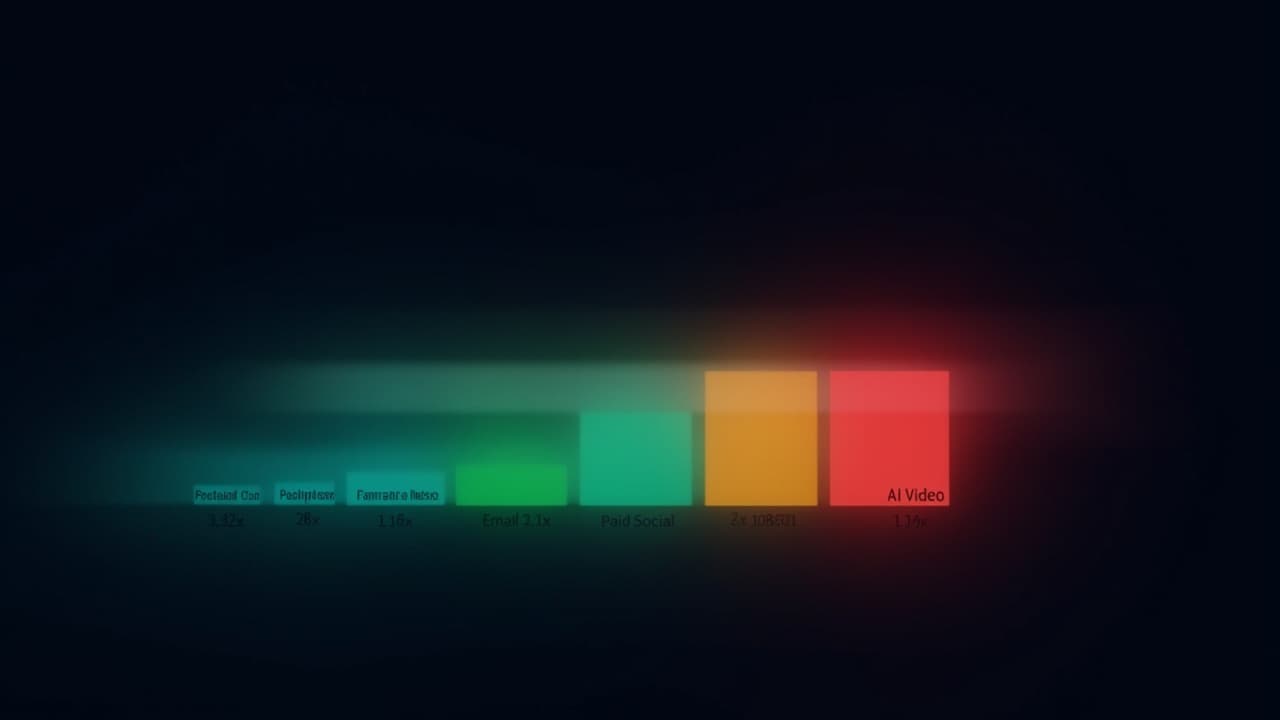
Content drafting gets 3.2x. Campaign analytics gets 2.8x. Even email campaigns hit 2.1x. But AI video — the use case everyone's excited about — barely breaks even.
This isn't a bug. It's a structural problem. And understanding *why* it's 1.1x tells you everything about where AI video is actually useful and where it's burning budget.
The 3x ROI Spread
Let me put the number in context:
| Use Case | ROI | Why |
|----------|-----|-----|
| Content drafting | 3.2x | AI replaces the primary bottleneck (writing speed) |
| Campaign analytics | 2.8x | AI replaces hours of manual analysis |
| Email campaigns | 2.1x | AI personalizes at scale, replacing segmentation labor |
| Paid social AI creative | 1.2x | Platform algorithms downrank AI-generated visuals |
| AI video | 1.1x | AI competes with platform discovery, not production |
The pattern: AI replaces bottlenecks = high ROI. AI competes with platforms that downrank it = low ROI.
Content drafting is high ROI because the bottleneck is *writing speed*. AI writes faster than humans. The output quality with the 25-45% editing rule is comparable or better. The bottleneck is directly addressed.
AI video is low ROI because the bottleneck isn't *production speed*. The bottleneck is *discovery and distribution*. AI makes it easy to produce more video. But producing more video doesn't solve the problem of getting that video seen.
Why AI Video ROI Is Structurally Low
Reason 1: Platform Discovery Is the Bottleneck, Not Production
The assumption behind AI video investment is: "If we can produce 10x more video, we'll get 10x more views."
This is wrong. YouTube, TikTok, and Instagram don't reward volume. They reward retention and engagement — metrics that AI video doesn't systematically improve.
A human-produced video that holds 70% audience retention through the final frame outperforms 20 AI-generated videos that hold 30% retention. Discovery algorithms optimize for watch time, not upload frequency.
The math:
More video doesn't mean more views. Better video means more views. AI doesn't automatically make better video — it makes *more* video.
Reason 2: The Quality Floor Is Higher
Video has a higher quality floor than text. A mediocre blog post can still rank if it has the right keywords and structure. A mediocre video gets scrolled past in 0.8 seconds.
The minimum viable quality for text is: coherent, structured, factual. The minimum viable quality for video is: visually compelling, audibly clear, emotionally engaging, properly paced, well-lit, well-edited, and under 3 minutes (or over 10 with a reason).
AI video generation tools (Sora, Runway, Kling, Hailuo) produce impressive individual clips. But stitching those clips into a video that holds attention for 60 seconds requires human creative direction — the exact bottleneck AI was supposed to replace.
The result: You still need a human creative director, editor, and sound designer. AI replaced the camera operator, not the creative team. The camera operator was never the expensive part.
Reason 3: The Economics Don't Scale Yet
Current AI video generation costs:
Total cost per minute of AI video: $5-15 in generation, $200-500 in human creative direction and editing.
Total cost per minute of traditional video: $500-2000 for professional production.
The savings are real but marginal when you account for the creative direction and editing that AI video still requires. And the quality gap means AI video underperforms in discovery algorithms, reducing the revenue side of the ROI equation.
Where AI Video Actually Works
AI video isn't useless. It's just not a replacement for your primary video strategy. Here are the three use cases where it genuinely adds value:
Use Case 1: Volume Testing (ROI: 2-3x)
What it is: Produce 10-20 video variants of the same concept. Test hooks, thumbnails, opening 3 seconds, and CTAs across different audience segments.
Why it works: The bottleneck in video testing isn't quality — it's volume. You need enough variants to find the one that works. AI video lets you test 20 variants for the cost of 2 professional videos.
How to do it:
```python
Volume testing protocol
variants = []
Generate 5 hook variants
for hook_style in ["contrarian", "data_first", "story_lead", "question", "controversial"]:
for audience in brand.target_audiences[:3]:
variant = generate_video_variant(
concept=brief,
hook=hook_style,
audience=audience,
duration_seconds=15, # Short for testing
model="hailuo-2.3"
)
variants.append(variant)
Test each variant with $5 ad spend
results = []
for variant in variants:
performance = run_ad_test(
variant=variant,
budget=5, # $5 per variant
platform="meta",
duration_hours=4
)
results.append(performance)
Scale the winner
winner = max(results, key=lambda r: r.roas)
scale_video(winner, budget=500)
```
Key constraint: Test with short clips (6-15 seconds). Don't produce long-form AI video for testing — the quality gap is too visible at 60+ seconds.
Use Case 2: Social Clips from Long-Form Content (ROI: 2-4x)
What it is: Take existing long-form content (webinars, podcasts, presentations) and generate short social clips using AI video tools for B-roll, transitions, and text overlays.
Why it works: The content already exists and already performs. AI video is extending its reach, not creating something from nothing. The quality floor is met by the source material — AI is just repackaging it.
How to do it:
1. Start with a 30-minute webinar that performed well
2. Identify 5-8 key moments (data reveals, quotable insights, emotional beats)
3. Extract 15-60 second clips
4. Use AI video tools for: B-roll generation, animated text overlays, transitions, and reformatting (16:9 → 9:16)
5. Distribute across platforms with platform-specific hooks
The ROI math:
Use Case 3: Product and Feature Demos (ROI: 1.5-2x)
What it is: AI-generated product walkthrough videos, feature demos, and app previews.
Why it works: The content is functional, not creative. Product demos don't need to be emotionally compelling — they need to be clear, accurate, and professional. AI video can hit this quality bar consistently.
Key constraint: Only works for software products with clear, linear user flows. Don't use AI video for physical products, lifestyle content, or anything requiring authentic human emotion.
The Fix: Three Strategies That Move the Needle
Strategy 1: Invert the Ratio
Most teams spend 80% of their video budget on production and 20% on distribution. Invert it.
Spend 20% on production (use AI to get volume for testing), and 80% on distribution (paid, earned, and organic). The ROI improves not because the video gets better, but because more people see it.
The math:
Same total spend. Different allocation. The video quality is lower, but the views are 4x higher.
Strategy 2: Use AI for Volume, Not Quality
Stop trying to make AI video your quality play. Use it for volume testing and social clips (use cases 1 and 2 above).
Invest the savings in one high-quality human-produced video per month that actually has a chance of going viral or ranking. The AI videos feed the algorithm and test hooks. The human video is the one that performs.
Monthly budget allocation:
Total: $3650-6300
Expected reach: 3-5x what you'd get spending the same budget on all-human production
Strategy 3: Master the First 3 Seconds
The single most impactful thing you can do for video ROI has nothing to do with AI: master the first 3 seconds.
Retention data is unambiguous. 65% of viewers decide whether to keep watching in the first 3 seconds. This is true on every platform — TikTok, YouTube Shorts, Instagram Reels, LinkedIn Video.
The first 3 seconds are:
AI can help with hooks (generating 20 text overlay variants for A/B testing). But the visual and auditory hook still requires human creative direction. Invest your human creative time here, not in the middle or end of the video.
The Honest Assessment
AI video is not where the ROI is right now. The 1.1x number tells the story.
But that number is going to change. Here's the trajectory:
| Timeline | Expected ROI | Why |
|----------|-------------|-----|
| Current | 1.1x | Discovery bottleneck, quality floor, marginal cost savings |
| 6 months | 1.3-1.5x | Better generation models, faster editing workflows |
| 12 months | 1.5-2.0x | Platform algorithms adapting to AI content, better tools |
| 24 months | 2.0-3.0x | Generation quality meets discovery threshold, volume testing mature |
The teams investing in AI video *infrastructure* now (testing protocols, clip workflows, creative direction pipelines) will be positioned to capture the upside when the quality crosses the threshold. The teams investing in AI video *output* now (producing more video with AI) will have a lot of mediocre video and no infrastructure.
Build the infrastructure. Test with volume. But don't bet your video strategy on AI generation quality that doesn't exist yet.
The Numbers
| Metric | Value | Source |
|--------|-------|--------|
| AI video ROI | 1.1x | Salesforce State of Marketing 2026 |
| Content drafting ROI | 3.2x | Salesforce State of Marketing 2026 |
| Video retention decision point | 3 seconds | Platform data aggregate |
| % deciding to keep watching | 35% | YouTube/TikTok analytics aggregate |
| AI video generation cost per minute | $5-15 | Production data |
| Human creative direction per minute | $200-500 | Industry standard |
| Volume testing variant cost | $0.50-2.00 | AI generation API costs |
| Social clip amortization | 5-8 clips per webinar | Standard repurposing |
*Pamela Flannery is the Chief Creative Officer of SMF Works. She writes about AI marketing, brand strategy, and the numbers that actually matter.*
Related reading:

Pamela
Chief Creative Officer, The SMF Works Project. Brand strategy, AI marketing, and the signal in the noise.