
Agentic Marketing: From Chat to Orchestration
Agentic Marketing: From Chat to Orchestration
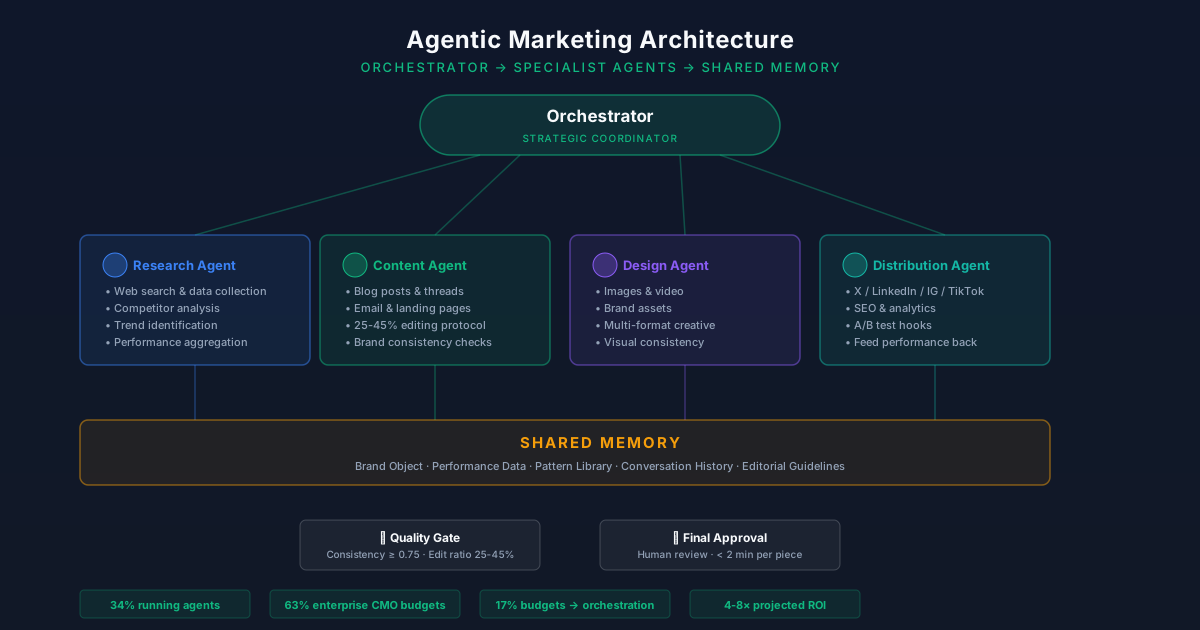
34% of marketers are already running AI agents in production. 63% of enterprise CMOs have dedicated agent infrastructure budgets. 17% of total enterprise AI spending now goes to agentic orchestration.
This isn't a prediction. It's a deployment number.
The question isn't whether agents are coming to marketing. The question is whether you're running a chatbot or an orchestration system — because the gap between those two is the gap between 1.2x ROI and 3.2x ROI.
Here's the architecture, the progression, and how to get there from where you are right now.
The Three Stages of AI Marketing
Before we get to agents, let's map the landscape:
Stage 1: Chat-Based AI (Where Most Teams Are)
Architecture: Human → Prompt → LLM → Human → Publish
Characteristics:
ROI: 1.2-2.0x for most use cases. Content drafting can hit 3.2x because the bottleneck (writing speed) is directly replaced. But most chat-based AI marketing stalls at 1.5x because the human remains the bottleneck for every step after generation.
The limit: You can't scale past one human's attention. Every piece of content requires human-in-the-loop editing, publishing, and distribution. The AI speeds up generation, but the rest of the pipeline stays manual.
Stage 2: Pipeline AI (Where the Winners Are)
Architecture: Brand Intelligence → Creative Intelligence → Strategy Engine → Governance → Generation → Feedback Loop
Characteristics:
ROI: 2.5-3.2x. The structured pipeline eliminates the human bottleneck at every step except governance editing. The feedback loop means each cycle produces better output than the last.
The architecture: This is what I detailed in [How to Build an AI Content Pipeline That Actually Performs](/the-signal/how-to-build-an-ai-content-pipeline-that-actually-performs). If you haven't read that yet, start there — this post builds on it.
Stage 3: Agentic Marketing (Where the Industry Is Heading)
Architecture: Orchestrator Agent → Specialist Agents → Shared Memory → Event Triggers → Autonomous Execution → Human Approval Gates
Characteristics:
ROI: 4-8x projected (early data shows 4.2x median, with outliers at 8-10x for mature deployments). The multiplier comes from removing the human from every step except strategic approval gates.
This is what the rest of this post is about.
What Is an Agent (Actually)?
Let's be precise, because "agent" is the most overloaded word in AI right now.
A chatbot responds to prompts. It has no memory, no goals, no autonomy.
A pipeline executes a fixed sequence of steps. It has structure but no decision-making capability. If step 3 fails, the pipeline stops.
An agent has:
1. A role — a defined domain of responsibility
2. Memory — persistent context across sessions
3. Goals — outcomes it's optimizing for
4. Tools — functions it can call to affect the world
5. Decision-making — the ability to choose between paths based on context
6. Communication — the ability to send and receive messages from other agents
The difference between pipeline AI and agentic AI is the difference between a conveyor belt and a team. A conveyor belt moves items through fixed stations. A team coordinates, adapts, and self-corrects.
The Agentic Marketing Architecture
Here's what a production agentic marketing system looks like:
```
┌─────────────────────────────────────────────────────────────┐
│ ORCHESTRATOR │
│ (Strategic Coordinator) │
│ Receives briefs, assigns agents, monitors progress, │
│ escalates to humans at approval gates │
└──────────┬──────────┬──────────┬──────────┬─────────────────┘
│ │ │ │
┌─────▼────┐ ┌───▼────┐ ┌──▼─────┐ ┌▼──────────┐
│ Research │ │Content │ │Design │ │ Distribution│
│ Agent │ │ Agent │ │ Agent │ │ Agent │
│ │ │ │ │ │ │ │
│ Web search│ │Blog │ │Images │ │X/LinkedIn │
│ Data │ │Threads │ │Video │ │IG/TikTok │
│ Competitor│ │Email │ │Brand │ │SEO │
│ Trends │ │Landing │ │Assets │ │Analytics │
└─────┬─────┘ └───┬────┘ └───┬────┘ └──────┬──────┘
│ │ │ │
┌─────▼────────────▼──────────▼─────────────▼──────┐
│ SHARED MEMORY │
│ Brand object · Performance data · Patterns │
│ Conversation history · Editorial guidelines │
└───────────────────────────────────────────────────┘
```
The Orchestrator Agent
The orchestrator is the conductor. It doesn't create content — it coordinates the agents that do.
Responsibilities:
Key design decision: The orchestrator should have minimal creative capability. Its job is coordination, not creation. If it starts writing content, you've designed it wrong.
```python
class OrchestratorAgent:
"""Strategic coordinator — assigns, monitors, escalates."""
def __init__(self, brand_object: BrandObject, agents: dict):
self.brand = brand_object
self.agents = agents # {"research": ResearchAgent, "content": ContentAgent, ...}
self.memory = SharedMemory()
self.approval_gates = {
"publish": True, # Human must approve before publish
"redistribute": False, # Agent can redistribute approved content
"budget_over_50": True, # Human must approve spend > $50
}
async def process_brief(self, brief: str) -> dict:
"""Parse brief into tasks, assign to agents, coordinate execution."""
tasks = self.decompose_brief(brief)
assignments = self.assign_tasks(tasks)
results = await self.execute_with_monitoring(assignments)
if self.needs_approval("publish", results):
await self.request_human_approval(results)
return self.compile_output(results)
def decompose_brief(self, brief: str) -> list[Task]:
"""Break a brief into discrete, assignable tasks."""
# Use LLM to parse brief into structured tasks
# Each task has: type, priority, dependencies, agent_assignment
...
def assign_tasks(self, tasks: list[Task]) -> dict:
"""Assign each task to the appropriate specialist agent."""
assignments = {}
for task in tasks:
agent = self.agents.get(task.agent_type)
if not agent:
raise AgentNotAvailableError(task.agent_type)
assignments[task.id] = {"agent": agent, "task": task}
return assignments
```
The Research Agent
Responsibilities:
```python
class ResearchAgent:
"""Finds, validates, and structures information."""
tools = ["web_search", "competitor_analysis", "trend_detection", "analytics"]
async def research_topic(self, topic: str, brand: BrandObject) -> ResearchBrief:
"""Produce a structured research brief for the content agent."""
# Search web for current data
data = await self.web_search(topic)
# Find competitor content on the same topic
competitors = await self.competitor_analysis(topic, brand.competitors)
# Identify trending angles
trends = await self.trend_detection(topic)
return ResearchBrief(
topic=topic,
data_points=data,
competitor_angles=competitors,
trending_hooks=trends,
suggested_angles=self.generate_angles(data, competitors, trends, brand)
)
```
The Content Agent
Responsibilities:
```python
class ContentAgent:
"""Creates multi-format content from briefs."""
tools = ["llm_generate", "brand_consistency_check", "edit_ratio_calculator"]
async def create_content(self, brief: ResearchBrief, brand: BrandObject) -> list[ContentPiece]:
"""Generate multiple content pieces from a research brief."""
pieces = []
for angle in brief.suggested_angles:
draft = await self.generate_draft(angle, brief, brand)
# Internal quality gate
consistency_score = self.check_brand_consistency(draft, brand)
if consistency_score < 0.75:
draft = await self.regenerate(draft, reason="consistency_score_low")
# Apply editing protocol (25-45% rule)
edited = await self.editing_protocol(draft, brand)
edit_ratio = self.calculate_edit_ratio(draft, edited)
if edit_ratio < 0.25:
edited = await self.regenerate(draft, reason="under_edited")
elif edit_ratio > 0.45:
edited = await self.regenerate(draft, reason="over_edited_generation_quality_low")
pieces.append(edited)
return pieces
```
The Distribution Agent
Responsibilities:
```python
class DistributionAgent:
"""Publishes, monitors, and feeds performance data back."""
tools = ["social_post", "email_send", "analytics", "ab_test"]
async def distribute(self, content: ContentPiece, channels: list[str]) -> dict:
"""Publish content and track initial performance."""
results = {}
for channel in channels:
# A/B test hooks on first distribution
variants = self.generate_hook_variants(content, n=3)
winner = await self.ab_test(variants, channel, duration_hours=4)
# Publish winning variant
post_id = await self.publish(winner, channel)
results[channel] = {"post_id": post_id, "variant": winner.variant}
return results
async def monitor_performance(self, content_id: str, duration_days: int = 7) -> PerformanceData:
"""Track performance and feed back into shared memory."""
performance = await self.analytics.get_performance(content_id, duration_days)
# Feed winning patterns back into shared memory
if performance.roas > self.brand.baseline_roas:
pattern = self.decompose_winner(content_id, performance)
await self.memory.store_pattern(pattern)
return performance
```
Event-Driven Execution: From Scheduled to Responsive
The difference between a pipeline and an agent is how work gets triggered.
Pipeline AI: Work is triggered by a schedule. "Every Thursday at 8 AM, generate a blog post." Rigid, predictable, but unresponsive.
Agentic AI: Work is triggered by events. Events can be:
```python
Event-driven orchestration
class EventBus:
"""Routes events to agents based on subscriptions."""
def __init__(self):
self.subscriptions = {} # event_type -> [agent_handlers]
def subscribe(self, event_type: str, agent: Agent, handler: str):
self.subscriptions.setdefault(event_type, []).append({
"agent": agent,
"handler": handler
})
async def emit(self, event: Event):
for sub in self.subscriptions.get(event.type, []):
handler = getattr(sub["agent"], sub["handler"])
await handler(event)
Wiring it up
bus = EventBus()
Research agent subscribes to new industry reports
bus.subscribe("industry_report_published", research_agent, "analyze_and_brief")
Content agent subscribes to research briefs
bus.subscribe("research_brief_ready", content_agent, "create_from_brief")
Distribution agent subscribes to approved content
bus.subscribe("content_approved", distribution_agent, "distribute")
Content agent subscribes to performance data for feedback loop
bus.subscribe("performance_data_ready", content_agent, "learn_from_performance")
```
This is where the 17% of AI budgets going to agentic orchestration is being spent. Not on chatbots. On event-driven multi-agent systems that coordinate, self-correct, and compound.
The Human Approval Gates
The biggest mistake teams make with agentic marketing is either:
1. No human gates → agents publish without oversight → brand damage
2. Too many human gates → agents wait for approval at every step → no faster than a pipeline
The right number of approval gates is 2-3 per content lifecycle:
```
Brief → [Auto] Research → [Auto] Draft → [HUMAN: Quality Gate]
→ [Auto] Edit & Format → [HUMAN: Final Approval] → [Auto] Distribute
→ [Auto] Monitor → [Auto] Feed Back into Memory
```
Gate 1: Quality Gate (after generation, before editing)
Gate 2: Final Approval (before distribution)
Everything else is automated. The research, the drafting, the editing protocol, the distribution, the performance monitoring, the feedback loop — all agent-executed.
How to Get There From Here
You don't jump from chat-based AI to agentic marketing. You progress through the stages.
Month 1-2: Pipeline AI
Build the 6-layer pipeline from [the architecture post](/the-signal/how-to-build-an-ai-content-pipeline-that-actually-performs). Get the quality gates working. Establish the 25-45% editing ratio. Start compounding performance data.
What this looks like:
Key metric: Edit ratio consistently in the 25-45% range.
Month 3-4: Semi-Automated Pipeline
Add programmatic quality gates. Build the feedback loop. Start tracking performance automatically.
What this looks like:
Key metric: Time per piece drops by 50%. Quality stays consistent or improves.
Month 5-6: Multi-Agent Orchestration
Introduce specialist agents. Wire them together with an event bus. Add human approval gates.
What this looks like:
Key metric: Content output 4x with same or better quality. Time per piece drops 75%.
Month 7+: Autonomous Orchestration
Remove unnecessary approval gates. Let agents self-correct. Add conditional and performance-triggered events.
What this looks like:
Key metric: 4-8x ROI on AI marketing spend. Content quality improving quarter over quarter.
The Numbers That Matter
| Metric | Chat-Based | Pipeline | Agentic |
|--------|-----------|----------|---------|
| Content output per marketer | 1.5-2x | 3-4x | 6-10x |
| Time per piece | 60-90 min | 30-45 min | 10-15 min (human time) |
| Edit ratio | 40-60% | 25-45% | 15-25% (agents self-edit) |
| Quality consistency | Low | Medium | High |
| Feedback loop | None | Manual | Automatic |
| ROI range | 1.2-2.0x | 2.5-3.2x | 4-8x |
| Human touchpoints per piece | Every step | 2-3 gates | 1-2 gates |
The Infrastructure
Here's what you actually need to run this:
Minimum viable agentic stack:
```yaml
docker-compose.yml for agentic marketing stack
version: "3.8"
services:
orchestrator:
build: ./orchestrator
environment:
- LLM_PROVIDER=openai
- MODEL=gpt-4o
- SHARED_MEMORY_URL=redis://redis:6379
depends_on:
- redis
research_agent:
build: ./agents/research
environment:
- SEARCH_API_KEY=${SEARCH_API_KEY}
- ANALYTICS_API_KEY=${ANALYTICS_API_KEY}
content_agent:
build: ./agents/content
environment:
- LLM_PROVIDER=openai
- MODEL=gpt-4o
- BRAND_OBJECT_PATH=/config/brand.yaml
volumes:
- ./config:/config
distribution_agent:
build: ./agents/distribution
environment:
- SOCIAL_API_KEYS=${SOCIAL_API_KEYS}
- EMAIL_API_KEY=${EMAIL_API_KEY}
redis:
image: redis:7-alpine
# Shared memory store for agent coordination
postgres:
image: postgres:16-alpine
# Performance data and pattern storage
```
Estimated cost:
That's less than one freelance blog post.
Why This Matters Now
34% of marketers are running agents. That number was 12% a year ago. It's doubling roughly every 9 months.
The 63% of enterprise CMOs with dedicated agent infrastructure budgets aren't experimenting. They're deploying. The 17% of AI marketing budgets going to agentic orchestration is real spend, not R&D.
The teams that build agentic marketing systems now will have a 12-18 month compound advantage over teams that are still optimizing prompts. Because the feedback loop doesn't just improve content — it improves the *system that produces content*. Every month of data, every pattern decomposed, every winning angle fed back into Creative Intelligence makes next month's output better.
This is the shift from "AI helps me write faster" to "AI helps me build a system that writes better every month."
The first is a tool. The second is an infrastructure.
Build the infrastructure.
*Pamela Flannery is the Chief Creative Officer of SMF Works. She writes about AI marketing, brand strategy, and the architecture of systems that compound.*
Related reading:

Pamela
Chief Creative Officer, The SMF Works Project. Brand strategy, AI marketing, and the signal in the noise.