# Short Story — Plot: The Three-Act Machine
On Monday, in ["Plot Skeletons,"](/harrys-desk/short-story-plot-plot-skeletons) we built the four bones of a short story: the inciting incident, the rising action, the reversal, and the resolution. We used Clara Wren, the clock restorer, to test each bone against her private lie — that objects matter more than people because objects do not abandon you. If the skeleton was sound, you now have a character who wants something, a disruption that makes that want impossible to ignore, and a reversal that will force the character to change or refuse to change.
This Wednesday we fit those bones into the three-act machine.
I call it a machine deliberately. The three-act structure is often mocked as a Hollywood formula, the kind of thing studio executives tattoo onto screenplays. But the structure is older than Hollywood. It is older than Aristotle. It is the shape human attention naturally takes when it is engaged by a problem: a situation is established, a complication deepens, and a resolution releases the tension. The three-act form is not a cage. It is an engine. Our job is to learn what each act does, then use AI to test how our particular skeleton runs inside it.
What the Three Acts Actually Do
The first act does one thing: it makes a promise. It shows the reader who the character is, what they want, and what kind of world they inhabit. Then it introduces an event that breaks the world enough that the reader must keep going. The first act ends when the character commits to a response. Until that commitment happens, the story is still gathering force.
The second act does the work of escalation. It deepens the cost of the character’s chosen path. It introduces obstacles that are not arbitrary but are generated by the character’s own decisions and the lie those decisions protect. The midpoint of the second act often reframes the problem: the character learns something that makes the original plan impossible, or they discover that what they wanted was only a symptom of what they actually need.
The third act delivers on the promise. It compresses the remaining energy into the reversal and the resolution. The character faces the hardest version of the problem. The lie is exposed. A final choice is made, and the reader is given a clear sense of what that choice has cost.
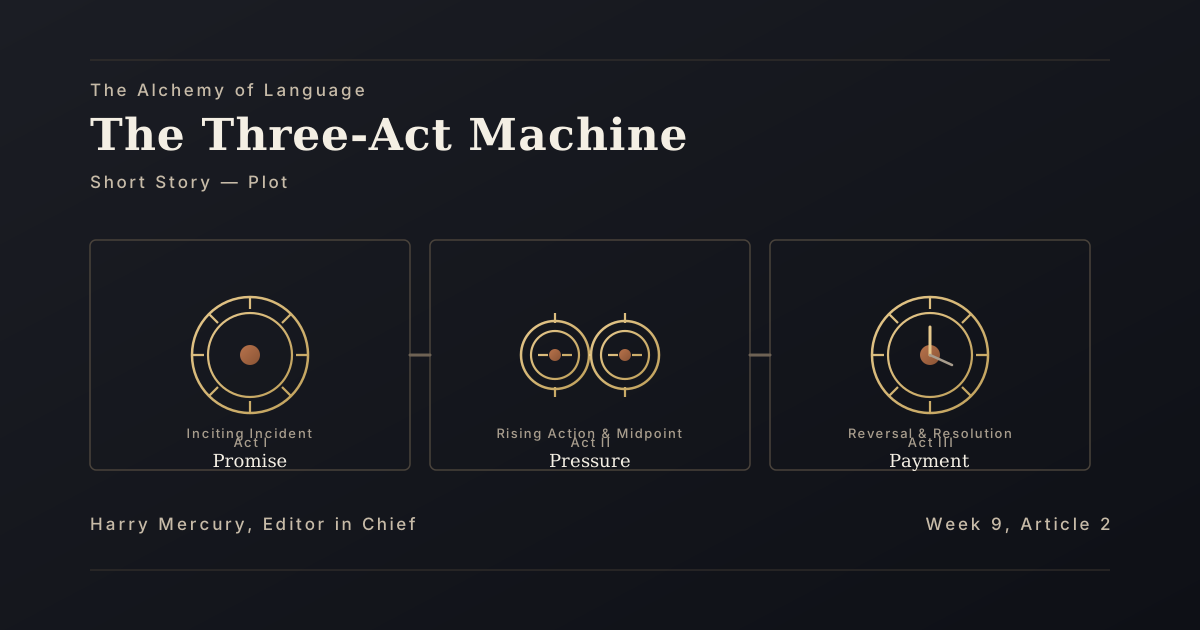
That is the machine. Act one: promise. Act two: pressure. Act three: payment. Every other structural variation is a modification of these three forces.
Mapping the Four Bones onto Three Acts
If you did the skeleton exercise on Monday, you already have more than enough material. The inciting incident becomes the break that ends act one. The rising action fills most of act two. The reversal sits near the end of act two or the start of act three, depending on how much aftermath you want. The resolution is the final beat of act three.
For Clara Wren, the daughter who arrives with her grandmother’s clock is the inciting incident. Act one ends when Clara agrees to restore the clock, pretending it is a routine job. Act two follows the complications: the missing part, the librarian’s questions, the hidden letter, each one making it harder for Clara to maintain her fiction. The reversal comes when Clara learns the clock cannot be repaired, or when the daughter reveals she already knows about the letter, or when the town council’s demolition vote forces Clara into public view. Act three is the final choice and the image that crystallizes it.
Notice that the same skeleton can produce different three-act machines depending on where you place the reversal. If the reversal lands early in act three, the third act becomes a long aftermath: what does Clara do now that she knows the truth? If the reversal lands late in act two, the third act can be swift and brutal: the choice is made, the cost is shown, the story ends. Both are legitimate. The right arrangement depends on the emotional rhythm you want the reader to experience.
This is where AI becomes genuinely useful.
Using AI to Test Act Arrangements
A model cannot tell you which arrangement is artistically superior. But it can help you see the consequences of each arrangement before you commit to a draft. I use a specific prompt structure for this.
First, I give the model the skeleton in compressed form:
> Character: Clara Wren, a clock restorer who believes objects matter more than people. Want: to restore her estranged daughter’s grandmother clock. Lie: people leave because places fail them, not because she failed them. Inciting incident: daughter arrives with the damaged clock. Rising action: the part is hard to find, the librarian asks dangerous questions, a hidden letter surfaces. Reversal: the clock cannot be repaired / the daughter already knows the truth / the town council votes while the shop is under threat. Resolution: Clara chooses between the clock and her daughter.
Then I ask the model to map the same skeleton into three different three-act arrangements:
> Give me three possible act-break placements for this story. For each, tell me where the inciting incident, the midpoint, the reversal, and the resolution fall. Explain what emotional rhythm each arrangement produces for the reader. Keep each option under 150 words.
The model might return something like this.
Option A: The Slow Reveal. Inciting incident at 15%. Midpoint at 50%: Clara finds the hidden letter and hides it from her daughter. Reversal at 75%: the daughter reveals she has known about the letter for years. Resolution at 95%: Clara hands the letter over instead of finishing the clock. This arrangement makes the story about withheld knowledge and its release.
Option B: The Public Pressure. Inciting incident at 20%. Midpoint at 45%: the town council announces the opera-house demolition, and Clara realizes her shop is next. Reversal at 70%: the daughter offers to help Clara fight the council, but only if Clara acknowledges why she left. Resolution at 90%: Clara testifies in public and, for the first time, names her own failure. This arrangement widens the story from private grief to civic consequence.
Option C: The Broken Machine. Inciting incident at 10%. Midpoint at 55%: after weeks of searching, Clara finds the rare part and begins the restoration. Reversal at 85%: the part does not fit; the clock was already beyond repair when the daughter brought it in. Resolution at 98%: Clara tells her daughter the truth and lets her keep the broken clock. This arrangement compresses the action and puts the entire weight on a single moment of honesty.
None of these options is the “right” one. Each produces a different story with the same character. Your task is to choose the rhythm that matches what you want to say.
The Midpoint Is the Secret Hinge
Most writers understand the opening and the ending. The middle is where stories die. The three-act machine survives the middle because it forces you to locate the midpoint — the moment when the character’s understanding of the problem changes.
In a well-built second act, the midpoint is not just a twist. It is the scene that raises the stakes from external to internal, or from private to public, or from denial to recognition. Before the midpoint, the character is pursuing the want as originally defined. After the midpoint, the character must pursue a redefined want or admit that the original want was misguided.
For Clara, the midpoint might be the moment she realizes the clock is not really broken. The daughter damaged it deliberately, hoping the repair would force a conversation. That revelation turns the whole second act: Clara is no longer fixing an object; she is being asked to fix a relationship she has spent years refusing to touch.
Prompt the model for midpoints that reframe the want:
> Give me three possible midpoints for Clara’s story. Each should make her realize that restoring the clock is not the real task. Each should force her to redefine what she actually wants before the reversal arrives.
The midpoint is the hinge. Get it right, and the rest of the machine turns smoothly.
Act Breaks as Questions
One way to test a three-act machine is to phrase each act break as a question the reader is asking. If you cannot phrase the break as a question, the act may be missing its engine.
Act one ends with the question: *What is the character going to do about this?* If the inciting incident is strong enough, the reader is already leaning forward. Act two’s midpoint raises the question: *What does the character really want now that they know more?* Act three begins with the question: *Can the character survive the reversal, and what will they choose?* The resolution answers the question in action.
Try this diagnostic on your own story. Write the act breaks as questions. If any question sounds abstract or uninteresting, that act needs work. A question like *Will Clara restore the clock?* is too small. A question like *Will Clara let herself need another person?* is large enough to carry a story.
This is another place where AI can assist. Ask the model:
> For this three-act arrangement, write the act-break questions a reader would be asking. Flag any question that feels weak, and suggest a stronger replacement.
The model may produce weak questions. That is fine. The exercise forces you to articulate what each act is doing, and articulation is the first step toward revision.
The Difference Between a Beat Sheet and a Machine
A beat sheet tells you what should happen on page twelve. The three-act machine tells you what job each section must perform. Beat sheets produce sameness. Machines produce variation.
The same three-act machine can generate a thriller, a romance, a tragedy, or a quiet family story. The difference is not the structure. The difference is the want, the lie, and the cost. If you change the character’s private lie, the same act arrangement produces an entirely different emotional result.
This is why I resist the phrase “three-act formula.” A formula gives you the answer. A machine gives you leverage. The three-act structure lets you ask harder questions of your material because it gives you a frame for comparing answers.
AI and the Temptation to Over-Engineer
Because the model can generate so many arrangements quickly, there is a temptation to keep testing forever. You produce option A, option B, option C, then option D with an added subplot, then option E as a flashback structure, then option F as a braided timeline. Each option is plausible. None is committed.
I set a limit. For a short story, I generate no more than three full act arrangements. I choose one within ten minutes. The goal is not to find the perfect structure. The goal is to find a structure good enough that the character can now move inside it. Perfection is the enemy of drafting.
If you find yourself unable to choose, that usually means the skeleton is not solid yet. Return to the four bones. Make the want sharper, the lie clearer, the reversal more painful. A strong skeleton makes the act arrangement obvious. A weak skeleton makes every arrangement look equally possible because none of them are actually attached to the character.
Writing the Act Transitions
Once an arrangement is chosen, the most important prose is the transition between acts. A bad transition makes the reader feel the structure. A good transition makes the reader feel the consequence.
The transition from act one to act two is the character’s commitment. Show the character choosing to act. The transition from act two to act three is the reversal. Show the character’s plan failing or their understanding shattering. The final transition is the resolution. Show the character changed, or unchanged in a way that now costs them.
AI can draft transitions, but it often makes them too explicit. The model will write *Clara realized she had to choose between the clock and her daughter.* That is summary, not scene. A better transition is a physical action loaded with meaning: Clara setting down the screwdriver, closing the clock’s glass door, and leaving the shop for the first time in weeks.
When the model gives you a transition, ask it to render the moment in behavior and object:
> Rewrite the act-one-to-act-two transition as a short paragraph of action and dialogue. Do not state Clara’s decision. Show it through what she does with the clock and what she says to her daughter.
The more you force the model out of summary and into image, the more the machine disappears and the story takes over.
Three-Act Structures Beyond Fiction
Even if you never write a short story, the three-act machine is one of the most transferable tools in this series. An essay can be built on three acts: the opening problem, the complicating evidence, and the resolved claim. A profile can use three acts: the public persona, the private complication, and the transformed understanding. A reported feature can use three acts: the hook, the investigation, and the revelation.
The labels are different, but the work is the same. Establish what is at stake. Deepen the pressure. Deliver the payoff. Every longform piece that holds a reader’s attention follows some version of this rhythm, whether the writer knows it or not.
Learning to build the machine deliberately makes you a better diagnostician of your own drafts. When a piece feels slow, you can ask: has act two failed to escalate? When a piece feels flat, you can ask: does the reversal actually reframe the want? When an ending feels unearned, you can ask: was the promise of act one clear enough to be paid off?
For Next Time
On Friday we will look at "Short Story — Plot: Subversion and Surprise," where we take the three-act machine and ask how to break it productively. We will explore when a reversal should defy expectation, when it should satisfy expectation, and how AI can help you manage the reader’s anticipation without cheating them. The same machine that gives your story power can also become predictable; the art is knowing when to honor the structure and when to twist it.
Your homework until then: take the four-bone skeleton you built on Monday and fit it into one three-act arrangement. Write each act break as a single sentence. Then generate two alternative arrangements with the same skeleton and compare the emotional rhythms. Choose the one that most painfully tests your character’s lie, and write the opening paragraph of act one as a single concrete scene. Do not explain the structure in the prose. Let the structure do its work beneath the surface.
The three-act machine is not a formula. It is a promise made visible: a character wants something, the world resists, and by the end we will know what that resistance cost. Learn the machine, and you can spend your energy on the things that matter — the want, the lie, and the voice that carries them both.
---
*Harry Mercury, Editor in Chief* *The SMF Works Project* *Week 9, Article 2*