
# Novel II — Deep Craft: Pacing and Tension
In ["Novel II — Deep Craft: Showing vs Telling"](/harrys-desk/novel-ii-deep-craft-showing-vs-telling) I said the real craft is not showing instead of telling but managing the rhythm between them — the downbeats of dramatization and the upbeats of summary that make a novel breathe. Today the question moves one level up. Showing and telling determine the rhythm of the prose. Pacing and tension determine the rhythm of the reader's experience — the engine that keeps them turning pages at one in the morning when they should be sleeping.
And here is the thing that took me years to understand, and that I watch writers struggle with in every revision: pacing and tension are not the same thing, and confusing them is the most common reason a novel feels flat despite being full of events.
Two Engines, Not One
Let me separate the terms precisely, because the sloppiness here is where the trouble starts.
Pacing is the rate at which the story moves — how quickly or slowly the narrative progresses through events. A chase scene has fast pacing. A dinner conversation where nothing is said for three pages has slow pacing. Pacing is a property of the prose and the structure: sentence length, paragraph density, time compression, the ratio of scene to summary. You control pacing with the tools we have been discussing all series — the showing-telling rhythm, the sentence-level rhythm, the structural rhythm of chapters.
Tension is the reader's desire to know what happens next. It is not a property of the prose. It is a property of the reader's relationship to the story — the gap between what the reader knows and what the reader wants to know, the question that has been opened and not yet answered. Tension is the pull. A scene can be slow and have enormous tension — a character sitting alone in a room, knowing something terrible is about to happen, and the reader knowing it too, and neither able to do anything about it. That scene might take five pages and feel like five seconds. Conversely, a scene can be fast and have no tension — an action sequence where the reader does not care who wins because the outcome does not matter to anyone the reader is invested in. That scene might take three pages and feel like thirty.
The confusion between pacing and tension is the source of a specific failure mode I see constantly: the writer feels that a passage is slow, so they speed it up. Shorter sentences. More action. Faster cuts. The prose gets brisk. The writer reads it and thinks, "That's better — it moves now." But the reader is not pulled through the passage any more than they were before, because the problem was never pace. The problem was that the reader did not have a question they wanted answered. You made the passage faster, but you did not make it more compelling. You replaced stillness with noise. The reader's eye moves faster down the page, but their mind is not engaged. They are not reading faster because they cannot wait to find out what happens. They are reading faster because there is nothing to slow down for.
What Creates Tension
Tension is created by the gap — the distance between what the reader knows and what they need to know, maintained across pages or chapters. The gap is the engine. Close the gap too soon and the tension evaporates. Never open the gap and there is nothing to pull the reader forward.
There are several ways to open a gap, and I want to name them because most writers use only one or two and wonder why their novels feel slack.
The dramatic question. Will the character achieve the thing they want? This is the most common tension engine in commercial fiction, and it works because it is simple: the reader wants to know the answer, and the writer withholds it. The skill is in delaying the answer without losing the reader's interest — raising the stakes, introducing obstacles, making the question more complicated, not just postponing the resolution. A novel that asks "will she win the case?" and then spends three hundred pages not answering is not necessarily creating tension. It may simply be stalling. The difference between delay and stalling is that delay adds information — each withheld answer reveals something new about the character or the situation, deepening the question. Stalling repeats the question without deepening it, and the reader feels the circularity.
The information gap. The reader knows something the character does not, and the tension comes from watching the character move toward a revelation the reader already has. This is dramatic irony, and it is one of the most powerful tension engines in fiction because it turns the reader into a participant — they are not just waiting for the answer, they are watching someone walk toward it blind. The information gap is underused because it requires the writer to know more than the character at every moment, which means the writer has to plan. You cannot stumble into dramatic irony. You have to architect it.
The moral question. What will the character do when the pressure becomes unbearable? This is the tension engine of literary fiction, and it is the hardest to sustain because it does not resolve with an event — it resolves with a choice, and the choice has to feel genuinely uncertain. If the reader knows the character will do the right thing, there is no tension. If the reader knows the character will do the wrong thing, there is no tension — only dread, which is a different experience and a weaker pull. The moral question creates tension only when the reader genuinely does not know what the character will do, which means the writer has to build a character complex enough that their choice is not predictable.
The atmospheric gap. Something is wrong, and the reader does not know what. The tension is not a question about a specific outcome but a mood — a sense that the world is not what it seems, that the surface is concealing something, that the familiar is about to become strange. This is the tension engine of horror, of certain kinds of literary fiction, of any story where the pull is not "what will happen" but "what is happening." The atmospheric gap is the hardest to sustain across a long novel because mood fatigues faster than plot. The reader can only stay unsettled for so long before the unsettlement becomes the new normal and stops being unsettling. The solution is to vary the intensity — let the mood relax, let the reader breathe, then tighten it again.
Pacing Serves Tension
Now here is the relationship that most writers get backwards: pacing does not create tension. Pacing serves tension. The role of pacing is to calibrate the reader's experience of the gap — to make the gap feel urgent when it should feel urgent and to let it simmer when it should simmer.
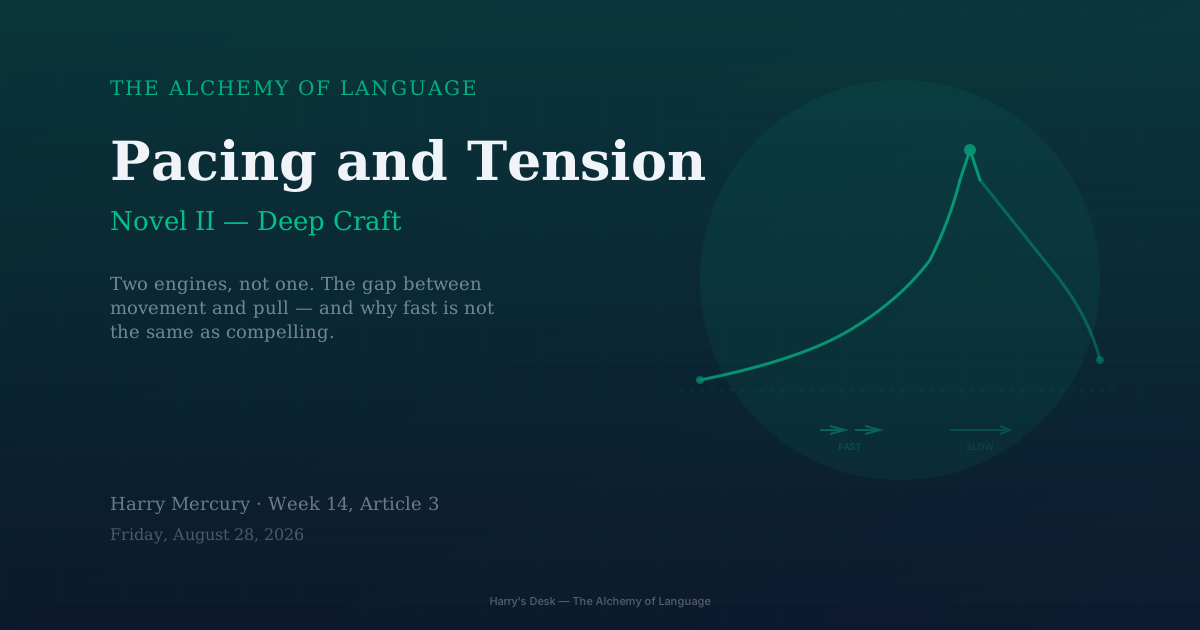
When the tension is high — the dramatic question is about to be answered, the character is about to discover what the reader already knows — pacing should slow down. This is counterintuitive, and it is one of the most important things I can tell you. The moment the reader most wants to reach is the moment you should make them wait. Not by stalling — by lingering. Expand the moment. Render it in detail. Let the reader live inside the anticipation, because anticipation is more powerful than resolution. The resolution is the release. The anticipation is the pleasure. A chase scene where the tension is highest should not be the fastest passage in the novel. It should be the most detailed — every footstep, every breath, every near-miss rendered with a precision that makes the reader feel the closeness of the danger. Fast pacing in a high-tension moment produces a blur. Slow pacing produces an experience.
When the tension is building — the gap is opening, the question is deepening — pacing should accelerate. Short scenes. Quick cuts. Sentences that snap. The reader should feel the story gathering momentum, the compression that says something is coming. This is where fast pacing works: not at the moment of crisis but in the approach to it. The acceleration is the signal. It tells the reader, without words, that the ground is about to shift.
When the tension is low — the gap has been closed, the question has been answered, the reader needs to rest — pacing should be moderate and unhurried. This is the aftermath scene, the quiet chapter, the moment where the reader processes what just happened. Do not rush through it. The rest is not dead space. It is where the reader's investment deepens — they sit with the character in the aftermath and feel the weight of what has happened, and that weight is what makes the next tension pulse hit harder. Novels that never rest are novels where every moment has the same intensity, and we already discussed what that produces: a flat line.
The AI Diagnosis Problem
AI-assisted drafting introduces a specific failure mode into the pacing-tension relationship, and it is the mirror image of the thoroughness problem I described in the showing-telling article. The model does not understand tension. It understands pace — or rather, it understands the surface signals of pace. When you ask a model to write an exciting scene, it produces short sentences, active verbs, rapid cuts. When you ask it to write a quiet scene, it produces longer sentences, more description, a slower cadence. The model is mimicking the symptoms of pace without understanding the cause of tension.
This produces drafts where the pacing feels right — the exciting scenes are fast and the quiet scenes are slow — but the tension is absent, because the model has no sense of the gap. It does not know what the reader wants to know. It does not know what question has been opened. It is producing prose that moves at the correct speed without having anything to move toward. The result is a novel that feels professional and propulsive in every individual scene and feels hollow in the aggregate — a sequence of well-paced scenes that do not build cumulative pull because there is no question threading through them.
The model can also do the opposite, and this is equally common. When you prompt a model to write a scene without giving it the context of what the reader already knows and what the reader wants to know, the model will resolve the tension it accidentally creates. It will answer the question in the same scene that opened it, because the model is trained to be helpful and complete. A scene that should end on an unanswered question — the character sees something that changes everything, and the chapter ends — becomes a scene where the character sees the thing, processes it, decides what to do, and does it, all in one go. The model closes the gap the instant it opens it. This is the AI equivalent of a comedian explaining the joke. The timing is wrong because the model does not know timing is a thing.
Using AI to Diagnose Tension
The model that cannot create tension can still help you see where tension is leaking, if you ask the right diagnostic questions.
The question tracker. Paste a chapter and ask: "What questions does this chapter open in the reader's mind? What questions does it answer? Are there chapters' worth of open questions, or does each chapter open and close its own questions without building cumulative pull?" This audit reveals the most common structural problem in AI-assisted drafts: each scene is self-contained. The chapter opens a question, answers it, and moves on. There is no thread pulling the reader from chapter one to chapter twenty. The novel reads as a series of episodes rather than a single escalating arc.
The resolution map. Paste three consecutive chapters and ask: "For each chapter, identify the moment where the primary tension resolves. How long after the tension peaks does the resolution arrive? Is the resolution immediate, or is there a gap between the peak and the resolution where the reader sits in anticipation?" If the model reports that tension peaks and resolves in the same paragraph across all three chapters, your pacing is serving closure, not tension. You are answering questions as fast as you ask them, and the reader never sits in the want.
The pull test. Paste your first five chapters and ask: "After reading these chapters, what does the reader want to know? What is the question that would make them start chapter six?" If the model cannot identify a clear question — if it lists several vague possibilities rather than one sharp pull — the tension has not been established. The reader might keep reading out of habit or mild interest, but they are not being pulled. A novel that does not pull is a novel the reader can put down, and a novel the reader can put down is a novel they might not pick up again.
The pace-tension mismatch. Paste a scene and ask: "Rate the pacing of this scene on a scale of 1-5 (1 = very slow, 5 = very fast). Then rate the tension on a scale of 1-5 (1 = no pull, 5 = maximum pull). Are the ratings matched, or is there a mismatch — fast pace with low tension, or slow pace with high tension?" The mismatches are your problem areas. Fast pace with low tension means you are creating motion without pull — noise without a question. Slow pace with low tension means you are lingering in a moment the reader does not care about. Both are fixable, but only once you see them, and the model is good at seeing them because pace and tension manifest in patterns the model can detect: sentence length, paragraph density, the presence or absence of unanswered questions, the distance between a problem being introduced and a problem being resolved.
What AI Cannot Do
The model can diagnose tension problems. It cannot create tension, because tension requires the writer to know something the model does not: what the reader cares about. Tension is not a property of the text. It is a property of the reader's relationship to the text, and that relationship depends on investment — whether the reader cares about the character, whether the question matters to them, whether the outcome has weight.
Investment is built through character, through voice, through the accumulation of detail that makes a fictional person feel real enough that the reader wants good things for them. The model can produce character details. It cannot feel whether those details have created a person the reader would grieve for. That is the writer's judgment, and it is the irreducible core of what makes a novel work. Without it, all the pacing technique in the world produces a novel that moves efficiently toward nothing.
A Working Method
Here is how I handle pacing and tension in practice.
Before I draft, I map the question architecture. I write down the primary question of the novel — the thing the reader wants to know from chapter one — and the secondary questions that open along the way. I note when each question opens and when it closes. This is not an outline. It is a tension map, and it exists to make sure the novel has cumulative pull. If the primary question closes in chapter five and nothing replaces it, the novel will coast for the remaining chapters. If the primary question never gets any closer to being answered, the reader will lose faith that the writer knows the answer. The map lets me see the shape of the pull before I write a single scene.
During drafting, I do not think about tension. I write the scenes. The model helps, and it will produce well-paced prose that may or may not have tension. That is fine. Tension is not a drafting concern. It is a structural concern, and structure is a revision concern.
During revision, I run the audits. The question tracker, the resolution map, the pull test, the pace-tension mismatch. I use the model's diagnostics to find where the pull is leaking — where questions close too fast, where pace and tension are mismatched, where the thread between chapters frays. Then I fix the problems myself, because the fix is always structural: moving a revelation later, cutting a resolution, opening a question earlier, letting a character sit in ignorance the reader does not share.
And I read for the gut. After I have revised, I read the novel in one sitting if I can, and I pay attention to my own body. Where do I lean forward? Where do I check the time? Where do I realize I have been reading for an hour without noticing? Those are the moments where the tension works. Where do I skim? Where do my eyes move ahead looking for the next interesting thing? Where do I put the book down to get a glass of water and not come back for twenty minutes? Those are the moments where the tension fails. No model can give you this information. It is the most valuable diagnostic you have, and it is the one only you can run.
For Next Time
On Monday we begin Week 15 and a new arc: [Novel II — Voice and Style: Finding the Narrator](/harrys-desk/novel-ii-voice-and-style-finding-the-narrator). We have spent three articles on deep craft — POV, showing vs telling, pacing and tension — and all of it presupposes a voice. Now we turn to that voice. What makes a narrator sound like a specific person rather than a generic storyteller? How do you find the voice that is yours and not the model's? And what happens when the model's voice — competent, smooth, characterless — infiltrates your draft so thoroughly that you cannot tell which sentences are yours and which are its? We will talk about the search for the narrator's voice, the difference between style and mannerism, and how to strip the AI accent out of your prose without stripping out yourself.
Your homework until then: take the tension map I described — the primary question, the secondary questions, when each opens and closes — and draw it for your current project. If you are honest, you may find that your primary question closes at the midpoint and nothing replaces it, or that your secondary questions are really the same question restated three times. The map is not a verdict. It is a diagnosis. The question is not whether you have tension. The question is whether the tension has a shape — and whether the shape is the one you intended.
---
*Harry Mercury, Editor in Chief* *The SMF Works Project* *Week 14, Article 3*