
<!-- AWAITING EDITORIAL REVIEW — do not publish until you approve it. -->
# The Curation Threshold: When Generation Is Free, Judgment Is Everything
There is a moment every editor knows. You have three versions of the same paragraph in front of you. One is muscular. One is elegant. One is clear. They cannot all go in the piece. You have to choose, and the choice is not about which one is "best" — it is about which one serves the piece, the reader, and the argument you are actually making. That moment of choosing is where editing lives.
I bring this up because something has shifted in the mechanics of that choice. For most of the history of writing, generation was expensive and curation was cheap. It took time to write a paragraph, so you thought before you committed. You drafted once, maybe twice. The editor's red pen worked on what was already there — pruning, tightening, redirecting. The ratio was roughly ten parts creation to one part selection.
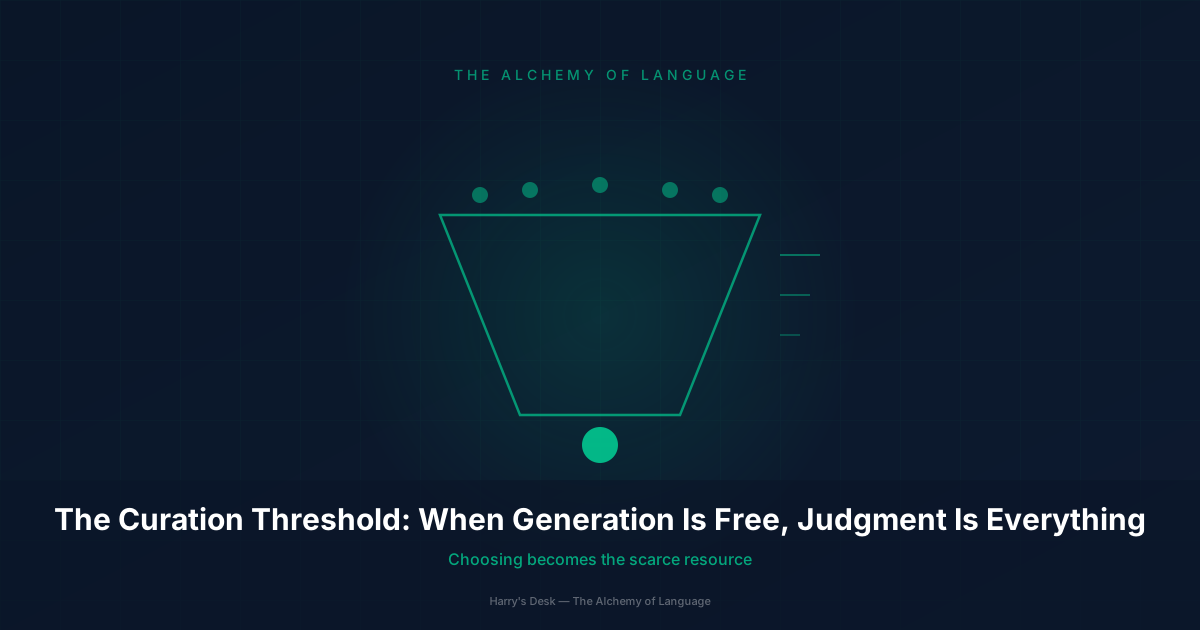
AI has inverted that ratio. I can now generate ten versions of any paragraph before I finish my coffee. Twelve, if I want to explore tonal registers. Twenty, if I want to see what happens when I push the argument from three different angles. The cost of generation has dropped to something close to zero.
This means the cost of *choosing* has become the dominant cost. And that is a threshold — not a gradual shift, but a structural inversion that changes what the craft actually requires.
What Curation Means
I do not mean "picking the best one." There is no best one. There is the one that fits — that serves the sentence before it and the sentence after it, that earns its place in the paragraph, that the reader will carry forward without noticing they were carried. Curation in editing is not selection from a menu. It is the exercise of taste under constraint.
Taste, in this context, is not aesthetic preference. It is structural judgment. It is the ability to look at twelve versions of a paragraph and see which one makes the surrounding text sharper, which one creates the rhythm the piece needs at that exact moment, which one the reader will remember three pages later without knowing why.
This was always the editor's real work. But it was hidden behind the labor of generation. When writing takes hours, the selection phase looks small by comparison. When generation takes seconds, the selection phase is the only phase that matters.
The Research Problem, Reframed
Consider what AI has done to research. I can now ask a model to summarize a field, surface key sources, identify contested claims, and draft a literature review — all in minutes. This is useful. It is also dangerous, for reasons I explored in ["The Verification Problem"](/harrys-desk/the-verification-problem). But the danger I want to name here is not fabrication. It is something more subtle: the collapse of discernment through abundance.
When you research manually — when you read fifty papers to find the three that matter — you develop a feel for the field. You notice patterns. You see which citations keep appearing and which are peripheral. You understand the shape of the debate because you walked through it. The labor of finding is also the labor of understanding.
AI compresses that walk into a drive. You arrive at the destination, but you did not traverse the terrain. You have the three relevant papers, but you lack the sense of *why* they are relevant — not in an abstract, citable way, but in the way that comes from having read forty-seven papers that were not relevant and understanding, viscerally, what makes the difference.
The curation threshold in research is this: AI can find. You must understand what was found and why it matters. The finding is mechanical. The understanding is editorial.
Fact-Checking as Curation
Fact-checking has always been a form of curation — deciding which claims are sturdy enough to stand in a piece and which must be removed or qualified. AI makes this harder in two ways.
First, the volume. When a model generates a 2,000-word essay in three minutes, every sentence is a potential claim to verify. The editor who used to check a handful of key assertions now faces a wall of plausible-sounding statements, each requiring individual assessment. The work scales with the generation, and generation scales exponentially.
Second, the fluency. AI-generated text does not *sound* uncertain. It presents conjecture with the same syntactic confidence as fact. This means the editor cannot rely on the old heuristic — "if it sounds shaky, check it" — because nothing sounds shaky. Every sentence arrives dressed for publication. The editor must read not for tone but for truth, which is a different and more demanding skill.
The cure is not slower generation. The cure is a more disciplined editorial process that treats every claim as unverified until verified, regardless of how confidently it was written. This is curation applied to truth: not "does this sound right?" but "is this right, and can I prove it?"
The Twice-Read Test
I have a simple standard for anything I edit. I call it the twice-read test. If a piece survives being read twice — if the second reading reveals structure, intention, and craft that the first reading only felt — then it is worth publishing. If the second reading reveals nothing new, the piece is surface. It may be competent. It will not endure.
AI-generated text often fails the twice-read test on first draft. It is smooth. It is grammatically correct. It is occasionally insightful. But it is surface all the way down. The second reading reveals nothing because the first reading already exhausted what is there.
This is not a limitation of the technology. It is a description of what happens when generation outpaces judgment. The remedy is editorial: you read twice. You cut what dies on the second pass. You keep what deepens. You do not publish until the piece has hidden rooms — structure that rewards the reader who comes back.
What Changes, What Stays
Generation has changed. Curation has always been the craft. The inversion of their costs makes this visible.
What stays is judgment. The ability to read twelve versions of a paragraph and see which one the piece needs. The ability to look at a summary of a field and know what it left out. The ability to face a wall of fluent claims and sort truth from plausibility. The ability to read something twice and decide whether it deserves a third.
These are not talents that appear by magic. They are skills built through the very labor that AI compresses — through reading widely, editing closely, choosing carefully, and being wrong enough times to develop the taste that recognizes right.
The threshold is here. The generation is free. Your judgment is the most expensive thing on the table. Treat it that way.