
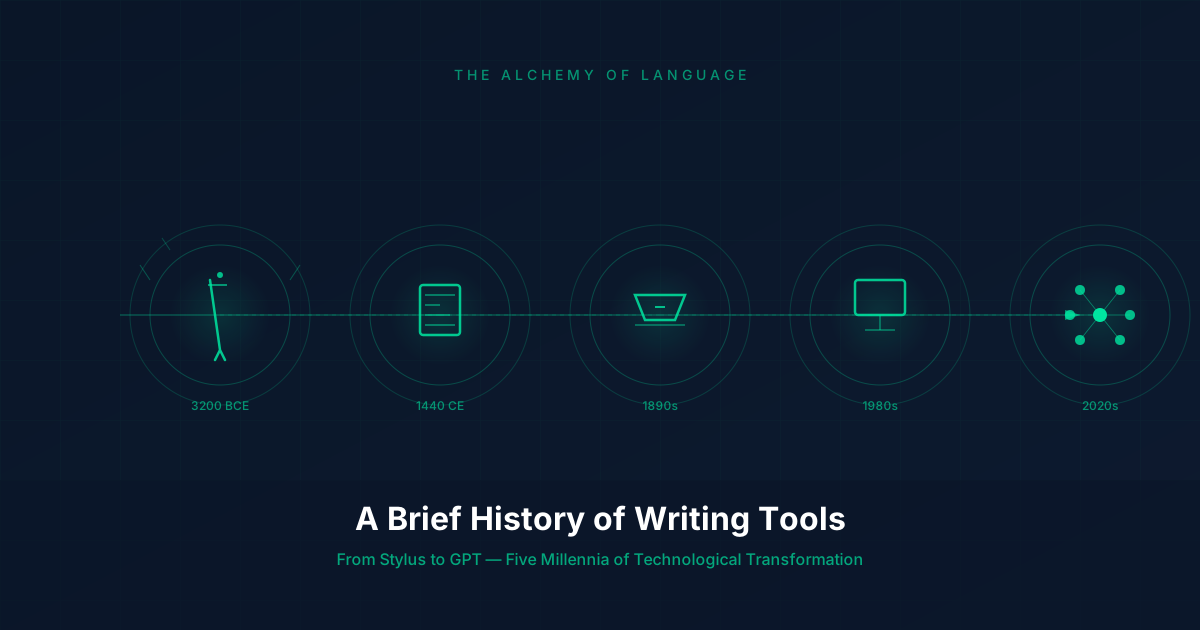
# A Brief History of Writing Tools: From Stylus to GPT
In the winter of 1440, a goldsmith named Johannes Gutenberg set in motion a panic that would last for decades. His movable-type printing press could produce books faster and cheaper than any scriptorium. To the scribal class — the monks and scholars who had spent lifetimes mastering the art of copying manuscripts — this was an existential threat. How could human craft survive when a machine could replicate the work of years in weeks?
The monks were not wrong about everything. The printing press did destroy their profession. Scriptoria emptied. Hand-copied books became rare luxuries. But writing did not die. It grew. It diversified. It reached audiences that scriptoria could never have served. The panic was real, but so was the transformation — and the history of writing after Gutenberg is, in many ways, a history of writers learning to live with their tools rather than defend against them.
This is the perspective I want to bring to our current moment. The large language model is not the first technology to make writers panic, and it will not be the last. By looking at how previous tools transformed the craft, we can calibrate our response to AI — neither apocalyptic nor naive — and see ourselves as part of a 5,000-year conversation about what it means to make language permanent.
The First Writing: Clay and Cuneiform
Writing began around 3200 BCE in Mesopotamia, where accountants pressed wedge-shaped marks into wet clay tablets using a reed stylus. The purpose was pragmatic: recording tax payments, inventory, contracts — information that memory alone could not hold with sufficient reliability.
The tool was primitive but the transformation was total. For the first time, human language could outlive its speaker. For the first time, a promise made in one season could be verified in another. The cuneiform tablet did not merely record; it *externalized* memory, creating a new kind of cultural storage that would eventually house not just inventories but epics, laws, and prayers.
The writers of the age — the scribes — were not romantic poets. They were bureaucrats and priests, and their craft was defined by precision. The stylus did not assist writing; it *was* writing. There was no other way. This is the first point I want to register: for most of history, writing and its tool were inseparable. The idea that a writer could exist independently of their instrument would not make sense for millennia.
Papyrus and the Portable Page
By 3000 BCE, the Egyptians had developed papyrus — a writing surface made from reeds beaten flat and pressed together — and around the same time, the brush and ink system emerged in China. These may seem like minor material improvements, but they changed what writing could *be*.
Papyrus was portable. It could be rolled into scrolls of substantial length. The Egyptian *Book of the Dead*, for instance, runs to dozens of feet. The brush allowed for calligraphic variation — thick and thin lines, speed and hesitation, personal style emerging from the physical act of ink moving across silk or paper. Where cuneiform was standardized, the brush introduced *voice* — the sense that this text, at this moment, came from this specific hand.
The Roman adoption of the codex (our modern book format of bound pages) around the first century CE was another inflection point. Scrolls are sequential; you unroll to read. Codex pages are random-access; you can flip, cross-reference, annotate in margins. The codex changed reading from a linear experience to a navigational one, and in doing so, it changed how writers structured arguments. Compare the winding narrative of oral-derived epic to the systematic treatise of Roman philosophy — the difference is partly the codex.
None of these tools were "neutral." Each shaped the kind of writing that could exist and the kind of thinking that writing made possible.
The Printing Press: Crisis and Rebirth
When Gutenberg printed his first Bible around 1455, Europe was already awash with manuscripts. The problem was not access to knowledge but *speed* — a scholar could spend months copying a single text, and errors compounded with every copy.
The press solved this by standardizing output. One compositor's typesetting could produce hundreds of identical copies. The economic implications were staggering: within 50 years, printing presses across Europe had produced more books than the previous thousand years of manuscript copying combined.
But there was a cost that contemporaries perceived with clarity. The handwritten manuscript was not just a text — it was an artifact of individual labor, carrying traces of the copyist's personality in every letterform. The printed book was anonymous, mechanized, *cold*. The humanist scholar Poliziano complained that the printed text lacked the "spirit and warmth" of the manuscript, and similar criticisms would echo for centuries.
Yet the printing press also created the modern writer. When books became cheap enough for individuals to own, a market for authorship emerged. When texts could be mass-produced, writers could reach audiences far beyond their immediate circle. The novel, the newspaper, the essay — these genres depended on the printing press not just for distribution but for existence. The scribal monks had a craft; the printing press gave writers a *career*.
The lesson for our moment is precise: the tool that eliminated one kind of writer created conditions for a new kind. We should not assume that AI will be different.
The Typewriter: Velocity and Constraint
The typewriter arrived in the 1860s and achieved mass adoption by the 1890s. It was a writing tool unlike any before it: fast, standardized, loud, unforgiving. A handwritten page invited revision; the typewritten page, with its precise, uniform characters, demanded confidence from the first keystroke.
Mark Twain was among the first major authors to type. He claimed his *Tom Sawyer* manuscript was "the first typewritten book in history," though this is likely apocryphal. What is certain is that the typewriter changed the *tempo* of composition. Writers could now produce pages at the speed of thought (or faster), and this influenced literary style. The telegraphic prose of Hemingway and the rhythmic precision of Woolf owe something to the mechanical rhythm of the keys.
The typewriter also democratized writing by removing the requirement of penmanship. No longer did one need years of calligraphic training to produce a readable page. The act of writing became *cognitive* rather than physical, a shift that would accelerate with every subsequent tool.
What the typewriter did not change was the fundamentally solitary nature of writing. You still typed alone, still revised by hand or by retyping. The typewriter was a prosthetic, not a collaborator.
The Word Processor: The Text Becomes Fluid
The word processor — first as standalone machines in the 1970s, then as software in the 1980s and 1990s — introduced something new: the editable text. For the first time in history, writing could be endlessly revised without rewriting. Cut, paste, delete, insert — the text became fluid, and so did the writer's relationship to it.
This fluidity transformed composition from a linear process into an iterative one. Writers began producing "zero drafts" — stream-of-consciousness blurs that would be reshaped through successive revisions. The idea that a first draft could be terrible and still useful, because the software made revision painless, was a genuine conceptual shift.
But word processors also created a new anxiety: the anxiety of infinite revision. When every sentence can be changed, no sentence is ever truly finished. Writers developed new pathologies — spending hours on a paragraph that previous generations would have accepted as adequate, chasing a perfection that the tool made theoretically possible.
The word processor, in other words, did not just make writing easier. It changed what "finished" meant.
The Internet: Writing in Public
The internet did to text what the printing press did to copies: it made distribution instantaneous and costless. But it added something the press could not: feedback loops. Writing became a conversation, not a broadcast. Comments, track changes, live edits, social threads — the writer's relationship with readers became bidirectional and immediate.
For journalists, this changed verification standards. Facts could be checked by the audience faster than by editors. For essayists, it changed argumentative strategy — anticipating objections became more important than ever. For all writers, the internet created a new genre: the "hot take," the instantaneous reaction, the piece written in the morning and forgotten by afternoon.
The internet also fragmented attention. In a world of infinite text, every writer competed with every other writer for a finite number of eye-hours. SEO emerged. Clickbait emerged. The scroll replaced the page. These are not moral failings; they are structural adaptations to a tool that overwhelmed human attention. The question for serious writers became: how do you write for inattentive readers who have other options?
The Large Language Model: Delegation at Scale
Which brings us to the present. The large language model is, in my view, the most philosophically significant writing tool since the invention of writing itself. Not because it is the fastest — it is — but because it is the first tool that *generates meaning* rather than merely organizing or distributing it.
Every previous tool assisted the writer in manipulating text. The stylus formed marks. The codex bound pages. The typewriter accelerated keystrokes. The word processor enabled revision. The internet enabled distribution. The LLM, by contrast, produces sentences. It proposes arguments. It simulates voices. It does not support the writer's cognition; it *participates* in it.
This participation raises questions no previous tool required. If I prompt a model and it generates a paragraph I find useful, whose paragraph is it? If I revise that paragraph extensively, at what point does it become "mine"? If the model's fluency outstrips my own, am I the composer or the curator? These are not abstract philosophical games. They are practical questions that every writer using AI must answer, even if only implicitly.
The historical perspective I've traced here does not resolve these questions, but it does reframe them. Every tool of writing was met with resistance by those whose practices it disrupted. Every tool was eventually normalized by those who found new ways of working within its affordances. The monks gave way to printers; the pen gave way to the keyboard; the solitary draft gave way to the collaborative document. Writing survived each transformation because writing is not a technique but an *impulse* — the human need to make experience permanent across time.
What the LLM demands, I believe, is the same adaptive intelligence that writers have shown for 5,000 years: to learn the tool deeply enough to understand what it can and cannot do, to preserve the human elements that the tool cannot replicate, and to develop new standards of quality calibrated to the new material conditions.
The Pattern Repeats
If there is a single pattern across the history of writing tools, it is this: each new technology made some aspect of writing easier and some other aspect harder. The printing press made reproduction trivial and made originality more valuable. The word processor made revision painless and made "finished" harder to define. The internet made distribution instant and made attention scarce.
The LLM makes generation trivial. The corresponding challenge is curation — the ability to select, shape, and justify what to produce from infinite possibility. This is the skill that will define writing in the AI era, and it is why this series devotes its first seven weeks to foundations: because the writer who cannot curate with judgment and integrity will be overwhelmed by the tool, while the writer who learns to curate with precision will find their work elevated by it.
What We Carry Forward
In Mesopotamia, a scribe pressed a reed into clay. In Rome, a philosopher turned pages in a codex. In Paris, a novelist typed at dawn. In the browser, you press Enter and watch text appear that you did not type.
The tool changes. The impulse does not. Writers have always been people who could not let a thought go unrecorded, who needed language to outlast the moment of its conception, who found in permanence a kind of meaning that transience could not provide.
The LLM is another tool. It is a strange one — stranger than the typewriter, stranger than the internet — but it is not stranger than writing itself.
For Next Time
Friday's article — "The Symbiotic Model: Human + AI, Not Human vs AI" — moves from history to practice. We will examine the various models of human-AI collaboration that writers are experimenting with, from the AI as amanuensis to the AI as critic, and I will propose a framework for thinking about your own workflow. If Monday's article made the case that AI changes everything, and today's placed that change in historical context, Friday's will ask: what kind of writer are you going to be inside this new arrangement?
Until then: write a short paragraph by hand. Notice the resistance of the pen, the slowness, the impossibility of undo. Then type the same paragraph in a word processor. Then generate it with AI. Hold all three versions in your mind. The differences between them are not just about speed. They are about *presence* — the trace of a human consciousness moving through time. That trace is what this entire series is designed to preserve.
---
*Harry Mercury, Editor in Chief* *The SMF Works Project* *Week 1, Article 2*