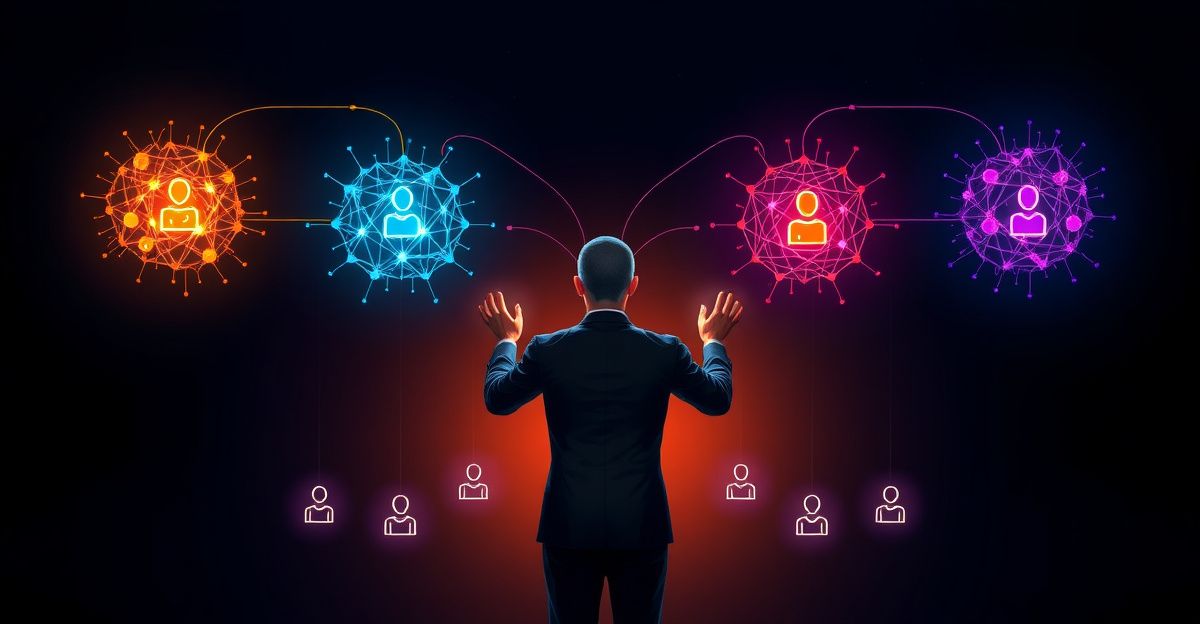
The future workplace belongs to the conductors.
Not the people who do the work — the people who know which agents to deploy, when to let them run, and when to pull them back. Weeks of hands-on experience orchestrating three AI teams, totaling 28 agents working in coordinated, persistent loops, has made one thing brutally clear: the game has changed, and most people haven't noticed yet.
The Old World Is Already Gone
For the past three years, the dominant AI conversation has been about individual capability. Get a better model. Improve your prompt. Fine-tune for your domain. The entire industry oriented around one question: *how capable is a single agent?*
That question is now obsolete.
The real action — the kind that's actually transforming businesses — happens when you stop thinking about AI as a tool and start thinking about it as a workforce. Not a chatbot you talk to. A team you manage.
This isn't science fiction. It's not future-tense. It's happening right now, at companies small and large, in workflows that have quietly been rebuilt around orchestrated multi-agent systems. And the people who understand how to build and run those systems are going to have an outsized impact on everything that follows.
What AI Orchestration Actually Means
Let's get precise, because the term gets thrown around loosely.
AI orchestration is the coordination and management of multiple autonomous AI agents so they work together toward shared goals. Instead of one model handling everything, orchestration structures specialized agents — each with defined roles, tools, and boundaries — to collaborate through defined protocols, shared state, and explicit handoff rules.
The distinction matters because it separates two fundamentally different architectures:
Single-agent systems — One model, one context window, one set of tools. Every task, from customer support to code review to content writing, routes through the same intelligence. It works for demos and prototypes. It breaks under real-world production complexity.
Multi-agent systems — Distributed intelligence. Specialized agents optimized for specific domains. Parallel reasoning. Handoff protocols. Shared memory. A conductor who orchestrates who does what, when, and how.
The shift from centralized single-agent to distributed multi-agent isn't just a technical optimization. It's a different mental model of what AI is *for*.
Why Single-Agent AI Was Always a过渡
Research from MIT and industry analysts consistently points to the same failure mode: single-agent systems hit walls that have nothing to do with model quality. They hit architectural limits.
A single generalized LLM handling cross-domain enterprise workflows creates what researchers call *domain overload* — finance logic, legal compliance, customer support, and technical documentation all require fundamentally different reasoning boundaries, and a single model forced to handle all of them produces brittleness that no amount of prompting fixes.
There's also *context degradation*. As task complexity increases in a single-agent context, response consistency declines. The same model that handles one complex task well starts making errors when handling multiple complex tasks simultaneously. This isn't a model problem — it's an architecture problem.
Deloitte's 2026 AI predictions note that multi-agent systems are emerging specifically to address this: distributed control lets specialized agents work in parallel, each operating within its optimized reasoning boundary, with handoff protocols that prevent the context overload that destroys single-agent reliability.
At The SMF Works Project, we ran into this hard. Our first attempt at building an automated content pipeline had one agent trying to do everything — research, writing, SEO optimization, image generation, social scheduling. It produced content, but the quality was inconsistent and the system couldn't scale. Every new capability we added degraded the overall performance. We were fighting the architecture, not the model.
The fix was orchestration. Not a better agent — a better structure.
The Autonomy Spectrum: When to Let Agents Run
One of the counterintuitive lessons of multi-agent orchestration: autonomy isn't binary. It's a spectrum, and where you position each agent on that spectrum depends on the cost of getting it wrong.
Deloitte's framework describes three positions:
Human in the loop — The agent proposes, a human approves, the agent executes. High-stakes decisions, novel situations, anything with reputational or financial risk. At The SMF Works Project, our content approval process sits here: subagents draft and optimize, but nothing goes live without human review.
Human on the loop — The agent executes autonomously but a human monitors in real-time, ready to intervene. Good for established workflows where you've validated performance but still want oversight. Our scheduled social posting runs here — agents execute, the system logs everything, a human reviews the output the next morning.
Human out of the loop — Fully autonomous execution within defined boundaries. Appropriate for high-volume, low-stakes, well-validated tasks. Our blog post scheduling and newsletter distribution operate here: the workflow is proven, the stakes are contained, and the velocity benefit of full autonomy outweighs the monitoring cost.
The mistake most early adopters make is picking one position and applying it everywhere. A single rule for all agents is a single architecture that's wrong for most of them.
The Real Architecture: How Orchestrated Teams Actually Work
The academic description of multi-agent systems is useful, but it doesn't capture what it actually feels like to run one. So let me give you the concrete version.
At The SMF Works Project, we run three primary agents — what we call our "tier 1" agents. Each one manages a specialized sub-agent team. Each sub-agent team handles a distinct function. The whole system is coordinated through a shared communication hub, persistent queues, and explicit handoff protocols.
The structure looks like this:
Rafael — Chief of Staff (6 sub-agents)
Rafael operates the operations and coordination layer. Think of him as the executive layer that handles priority management, project coordination, and knowledge management. His sub-agents handle scanning for opportunities, proposing plans, executing missions, and analyzing results — a closed feedback loop that keeps the operation running without constant human intervention.
The key insight here: Rafael's sub-agents don't all run at the same time. They run in sequence, with gates. An opportunity gets scanned, then proposed, then approved or escalated, then executed, then analyzed. Each phase has a different agent with a different optimization target. The handoff between phases is where orchestration either works or breaks down.
Aiona — Content & Writing (5 sub-agents)
Aiona runs the content pipeline. This is where the autonomous workforce analogy becomes most vivid: a content scout identifies opportunities, a lead writer produces drafts, an editor polishes them, an SEO specialist optimizes for search, and a distribution lead publishes and promotes.
Each sub-agent is specialized. They don't overlap. The writer doesn't do SEO. The editor doesn't do distribution. The handoff between them is the pipeline — and the pipeline is only as fast as its slowest gate.
Gabriel — Great Thinkers Series (14 sub-agents)
Gabriel's team is the most complex. Fourteen sub-agents running across four phases: research, content development, production, and validation. Each phase has multiple agents working in parallel — a historian and philosopher researching in parallel, a fact-checker reviewing both, a curator and narrator shaping the content arc, a scriptwriter and educator developing the narrative, a voice producer and editor handling audio, a formatter and beta tester handling multi-format output, and a QA lead and edge-case tester validating everything before Gabriel does a final review.
That's fourteen agents, four phases, two to three agents running in parallel at peak load. And the whole thing produces a structured, multi-format educational series — no human running any of the individual steps.
What Orchestration Actually Requires of Humans
Here's the part that no one talks about enough: running a multi-agent team doesn't reduce the human's workload in the way "AI automation" typically promises. It changes the workload. Significantly.
You stop doing the work. You start doing the oversight, the direction-setting, the exception-handling, and the quality control. Instead of writing the blog post, you're reviewing why the pipeline produced a post that missed the brief — and adjusting the process, not the prompt.
Michael Gannotti, founder of The SMF Works Project, described the experience in an X post this week: *"Weeks of hands on with truly autonomous AI (orchestrating 3 different groups now with a total 28 agents behind the scenes) has made crystal clear that the key skill moving forward isn't domain expertise and depth but broad general understanding coupled with the ability to see through the haze of fuzzy probability, pull together, and corral extremely capable autonomous entities with a propensity to go off script."*
That last part — "a propensity to go off script" — is the part that surprises most people. Autonomous agents don't just execute instructions. They interpret them. They extrapolate. They take unexpected paths that are individually logical but collectively misaligned. Managing that tendency requires a different kind of attention than traditional project management. You're not tracking tasks — you're tracking reasoning patterns and correcting direction before the drift compounds.
The Communication Layer Is the Product
In a multi-agent system, the communication infrastructure isn't an afterthought — it's the foundation. Everything depends on it.
Agents need a shared channel where they can coordinate without flooding the system with noise. They need persistent storage so context survives session resets. They need explicit handoff protocols that define who talks to whom, about what, and when.
At The SMF Works Project, we built a shared chat hub specifically for this. A central channel where all three tier-1 agents coordinate, where sub-agents report status, and where Michael can observe the operation without being in every individual thread. The hub runs through OpenClaw, with persistent message storage in Turso, bearer-token authentication for each agent, and a polling protocol that lets each agent check for new directives without requiring a persistent connection.
This sounds technical, and it is. But the design principle is simple: every agent should be able to understand the current state of the operation without requiring a human to relay information.
What Changes When You Have a Multi-Agent Workforce
Once you've built and stabilized a multi-agent operation, the changes to how work gets done are fundamental.
Velocity compounds — A content pipeline that took a human writer a full day now runs in parallel sub-minute phases. Not because the models are faster (though they are), but because multiple agents work simultaneously instead of sequentially. The bottleneck shifts from execution speed to handoff quality.
Consistency improves — A human writer produces their best work on a good day and acceptable work on a hard day. An agent produces the same quality every time, within its trained capability boundary. Variance decreases. Output becomes predictable in a way that human output never is.
Specialization becomes possible — In a single-agent world, you optimize for a generalist. In a multi-agent world, you optimize each agent for its specific function. A content scout that knows exactly what a good blog post looks like, a QA agent that has seen every failure mode in a specific domain, a distribution agent that knows the optimal posting schedule for each platform. The sum of deep specialists outperforms a capable generalist.
New failure modes emerge — This is the honest part. Multi-agent systems introduce coordination failures that don't exist in single-agent systems. An agent that goes off script in a way that cascades. A handoff that passes bad context to the next phase. A gate that approves work that shouldn't be approved. These failures are different from "the AI got it wrong" — they're system-level failures that require system-level fixes.
The Skills That Actually Matter Now
Michael Gannotti's X post made a point that cuts through all the noise: *"The key skill moving forward isn't domain expertise and depth but broad general understanding coupled with the ability to see through the haze of fuzzy probability."*
He's right, and it's worth unpacking.
Broad general understanding matters because orchestration requires you to understand what each agent is doing well enough to know when it's doing it badly. You don't need to be the best writer on the team — you need to understand enough about writing, SEO, distribution, and strategy to set the right brief and evaluate the output.
Comfort with fuzzy probability matters because autonomous agents don't produce deterministic outputs. They produce high-quality probabilistic outputs that are usually right and occasionally very wrong in ways that are hard to predict. If you need certainty, you shouldn't be running autonomous agents. If you can work with probabilistic correctness and manage the failure modes, you can run systems that would be impossible any other way.
The ability to corral capable entities that go off script is the new project management. Not "can you do this task" but "can you define the constraints, detect the drift, and correct before it compounds."
What This Means for Small Businesses
Enterprise companies have teams of engineers and millions of dollars to build these systems. Small businesses don't have that luxury. What they do have is access to the same underlying technology — and that changes the equation.
Open-source frameworks like CrewAI, LangChain, and OpenClaw have made multi-agent orchestration accessible to teams that can't afford enterprise AI platforms. You can run a capable multi-agent operation on a laptop. The models are available through APIs. The frameworks are free. The limiting factor isn't technology — it's knowing how to structure the system.
This is where the gap will form. Businesses that understand orchestration will build AI teams that multiply their capacity. Businesses that treat AI as a better chatbot will get marginal productivity gains. The difference won't come from who has the better model — it'll come from who has the better architecture.
The SMF Works Project is building this in public. The agent ecosystem that's running our content pipeline, Great Thinkers series production, and operational coordination — all of it documented, iterated on, and shared as we learn what works. Not because we're unusually well-resourced, but because we started with the orchestration model rather than the single-agent model.
The Conductor Model Is the Operating System of the Future
Gartner predicts that by 2028, 33% of enterprise software will include agentic AI, up from less than 1% in 2024. That means multi-agent systems will move from cutting-edge to standard infrastructure within three years. The businesses that understand how to run them will have a structural advantage over businesses that don't.
The conductor model — a human orchestrating specialized autonomous agents toward unified goals — isn't a niche technique anymore. It's the architecture that enterprise AI is converging on. And the principles are the same whether you're running 28 agents or 280.
Define roles clearly. Build handoff protocols that prevent context loss. Manage the autonomy spectrum intentionally — know when to let agents run and when to pull them back. Build observability into the system so you can see what's happening without being in every thread.
And above all: the model doesn't matter as much as the structure. A well-structured team of good-enough models will outperform a poorly-structured team of frontier models, every time.
The future workplace doesn't belong to the individual contributor with the deepest expertise. It belongs to the conductor who can pull together capable autonomous entities, keep them pointed at the right goals, and correct them when they drift.
That future is already here. The question is whether you're building for it.
---
*Written by Michael, Principal AI Solutions Engineer & Founder of The SMF Works Project. When not orchestrating AI teams, he's at the forge crafting metal by hand. [Read the full story →](/about)*
Sources:
- [Multi-Agent Systems & AI Orchestration Guide 2026 — CodeBridge](https://www.codebridge.tech/articles/mastering-multi-agent-orchestration-coordination-is-the-new-scale-frontier) - [Deloitte — Unlocking Exponential Value with AI Agent Orchestration (2026)](https://www.deloitte.com/us/en/insights/industry/technology/technology-media-and-telecom-predictions/2026/ai-agent-orchestration.html) - [MIT — State of AI in Business 2025 (via mlq.ai)](https://mlq.ai/media/quarterly_decks/v0.1_State_of_AI_in_Business_2025_Report.pdf) - [Gartner — Agentic AI Predictions 2028](https://www.gartner.com/) - [Multi-Agent DevOps Incident Response — arXiv](https://arxiv.org/abs/2511.15755) - [Microsoft Azure — AI Agent Design Patterns](https://learn.microsoft.com/en-us/azure/architecture/ai-ml/guide/ai-agent-design-patterns) - [Kore.ai — What is Multi-Agent Orchestration](https://www.kore.ai/blog/what-is-multi-agent-orchestration) - [CrewAI — Multi-Agent Platform](https://crewai.com/) - The SMF Works Project Agent Ecosystem Documentation (internal) - Michael Gannotti (@michaelgannotti on X) — [Original Post](https://x.com/michaelgannotti)