# Skill Acquisition in AI Agents: Why Persistent Knowledge Compounds Past Zero-Shot Every Time
There's a pattern I see every single week, and it costs teams more than they realize.
Someone starts a fresh chat with Claude or GPT. They explain their project architecture. They describe their conventions. They walk through the deployment pipeline. They clarify the monorepo layout. Twenty minutes in, the model is finally calibrated enough to be useful. They ship one feature, close the tab, and every bit of that context vanishes into the ether.
Next session? Start over. Explain the same architecture. Describe the same conventions. Walk through the same deployment pipeline.
This is the zero-shot tax. And it's staggering.
The Zero-Shot Tax Is Real
Let's quantify it. A typical mid-sized project has:
- Architecture context: Services, data flow, API contracts, database schemas (~2000-4000 tokens) - Conventions: Naming, file structure, linting rules, PR templates (~500-1500 tokens) - Deployment pipeline: Environments, CI/CD, staging workflow, rollback procedures (~800-1500 tokens) - Domain knowledge: Business logic, user roles, data models, permissions (~1500-3000 tokens)
That's 5000-10000 tokens of prerequisite context before the model writes a single useful line of code. At current GPT-4-class pricing, that's roughly $0.10-$0.30 per conversation start. Not catastrophic in isolation.
But the real cost isn't the tokens. It's the time. It takes 5-20 minutes to verbally reconstruct this context every session. If your team starts 10 conversations per day across 5 developers, that's 50 conversations × 15 minutes = 12.5 hours per day spent purely on context reconstruction. Hours that produce zero output — just warm-up overhead.
Over a month, that's 250 hours. Over a year, 3000 hours. Three thousand hours of your team's collective time, spent re-explaining things to an AI that should already know them.
What Skills Actually Are
In Hermes, a skill is a markdown document. That's it. No special syntax, no schema, no build step. You write a procedure — like how to deploy to your staging environment, or how your API error handling works, or what the PR review checklist looks like — and save it as a `.md` file.
Here's what a skill looks like in practice:
```markdown --- name: deploy-to-staging description: Deploy the main branch to staging with zero-downtime rollout category: devops ---
# Deploy to Staging
Prerequisites - Staging SSH access configured - Environment variables set in `.env.staging`
Steps 1. `git fetch origin main && git checkout main && git pull` 2. Run `npm run build` — zero errors required 3. Run `npm run test:integration` — all green 4. `ssh staging "cd /app && git pull && npm install && npm run build"` 5. `ssh staging "pm2 reload app --update-env"` 6. Verify: `curl -s https://staging.example.com/health | jq .status`
Rollback `ssh staging "pm2 revert"` — reverts to previous process snapshot.
Pitfalls - Never deploy on Fridays (policy, not technical) - If `npm run build` fails, check Node version matches production - Staging DB resets every Monday — don't run migrations on Monday ```
When you tell Hermes "deploy to staging," it loads this skill. The model now has precise, project-specific instructions without you re-explaining anything. The context cost drops from ~2000 tokens of verbal explanation to ~150 tokens of skill loading overhead plus your intent.
The ratio: 13:1. Thirteen tokens of manual context for every one token of skill-loaded context.
The Compounding Effect
Here's where it gets interesting. Skills don't just save time linearly. They compound.
Week 1: Manual Everything
You start fresh. Every session begins with context reconstruction. You might identify patterns and think about documenting them, but you're too busy shipping to write skills.
Effective output: ~60% of session time spent on actual work. 40% on context.
Week 2-3: Skill Creation
You start writing skills. Your first few cover the biggest pain points: deployment, database conventions, the API structure. Initial investment: maybe 2-3 hours total. Each skill takes 15-30 minutes to write.
Effective output: ~70% of session time. You've paid the skill-creation cost, and now every session starts with skills loaded instead of verbal context.
Week 4+: Compounding
Here's the key inflection point. Now when you encounter a new pattern or learn from a mistake, you can:
1. Update an existing skill (5 minutes) — every future session benefits 2. Create a new skill (15-30 minutes) — permanently captures that knowledge 3. Share skills across the team — everyone gets the same context bootstrap
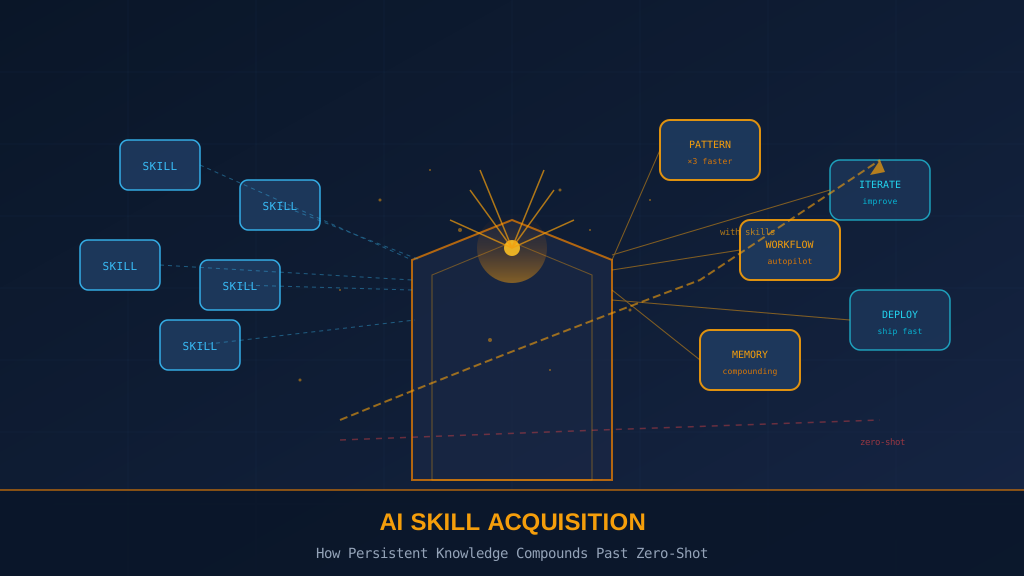
Your effective output climbs to 80%, then 85%, then 90%+ as your skill library grows. And the more you work, the more patterns you capture, the faster the next session starts.
This is the same compounding curve that knowledge management tools promise but rarely deliver, because skills are loaded actively into the model's context — not passively searched like a wiki. The agent doesn't need to "find" relevant documentation. It already has it.
Why Zero-Shot Can't Compete
Zero-shot prompting treats every interaction as a blank slate. The model brings its training data, which is broad and general. You bring your project specifics, which are narrow and essential.
The result is a constant tug-of-war. Your instructions get longer and longer as you try to compensate for the model's ignorance. Your context window fills with exposition instead of productive work. And the model still occasionally hallucinates project-specific details because it never *learned* them — it was just told them, once, for this conversation.
Skills flip this dynamic. Instead of explaining your project 100 times, you explain it once in a skill. The model loads it every time. The conversation starts at "I know the architecture, what are we building?" instead of "Please explain your tech stack."
Consider the difference:
Without skills (zero-shot):
```
You: We use Next.js 15 with App Router, PostgreSQL via Prisma, and deploy to Vercel.
Our API routes are in app/api/ and follow REST conventions. Error responses
use { error: string, code: number } format. Auth is via next-auth with GitHub
provider. Tests use Vitest with MSW for mocking. Don't use useEffect for data
fetching — we use Server Components. Our database migrations are in prisma/migrations/
and we never push schema directly. PRs need two approvals...
AI: Got it. What do you need?
You: Add an email verification flow. ```
With skills:
```
[Auto-loaded: project-architecture, api-conventions, database-conventions, pr-workflow]
You: Add an email verification flow. ```
Same knowledge. One is permanently captured. The other evaporates when you close the tab.
The Skill Taxonomy That Works
Not all skills are created equal. After writing dozens of skills across SMF Works projects, a clear taxonomy has emerged:
1. Procedure Skills (The Workhorse)
Step-by-step instructions for common operations. Deployment, database migrations, release processes. These are the highest-ROI skills because they replace error-prone verbal context with precise, tested instructions.
Template: Prerequisites → Steps → Verification → Rollback → Pitfalls
2. Reference Skills (The Atlas)
Architectural maps, data models, API contracts, environment layouts. These give the model a mental model of your system rather than a sequence of actions.
Template: Overview → Components → Relationships → Constraints
3. Convention Skills (The Style Guide)
Naming rules, file organization patterns, code style preferences. These prevent the model from generating code that "works" but violates your team's conventions.
Template: Rules → Examples → Anti-patterns
4. Troubleshooting Skills (The War Stories)
Problems you've encountered and solved. These are the most valuable skills over time because they encode hard-won knowledge that can't be derived from general training data.
Template: Symptom → Root Cause → Resolution → Prevention
5. Cross-Reference Skills (The Index)
Skills that point to other skills. These create a knowledge graph that lets the agent discover related procedures without loading everything into context.
Template: When → Load These Skills → Priority Order
Skills vs. RAG vs. Fine-Tuning
A common question: why not use RAG (Retrieval-Augmented Generation) or fine-tuning instead?
RAG is excellent for large document corpora — your documentation site, your knowledge base, your legal compliance library. But RAG retrieves *passages*. It doesn't give the model *procedures*. A retrieved paragraph about your deployment process is not the same as a step-by-step skill that the model can execute. RAG answers "what does the docs say?" Skills answer "how do I do this?"
Fine-tuning is powerful for teaching a model a new style or domain, but it's expensive, slow to update, and overkill for project-specific procedures that change weekly. You don't fine-tune a model on your deployment checklist. That's absurd. You give it a skill.
Skills occupy the sweet spot: structured, procedural, easily updated, loaded on demand, and immediately actionable. They're the difference between the model *knowing about* your project and *knowing how to work within* your project.
The three complement each other:
| Layer | Best For | Update Speed | Cost | |-------|----------|-------------|------| | Fine-tuning | Style, domain knowledge | Weeks | High | | RAG | Large document search | Hours | Medium | | Skills | Procedures, conventions, workflows | Minutes | Near zero |
The Anti-Pattern: Over-Skilling
Skills can be overdone. Here are the warning signs:
Too granular: A skill per API endpoint is overkill. Group related endpoints into a single "API Conventions" skill. The model can parse a list of 20 endpoints from one document faster than it can load 20 separate skills.
Too stale: Skills that describe obsolete processes are worse than no skills at all. If your deployment process changed last month, your "deploy-to-production" skill is now actively misleading. Treat skills like code: review and update them.
Too generic: A skill that says "write clean code" adds zero value beyond the model's training. Skills should be *specifically wrong if applied to a different project*. If your skill would work equally well at any company, it's not a skill — it's a platitude.
Getting Started: The 80/20
If you're just starting with skills, don't try to document everything. Write these three first:
1. Project Architecture — What services exist, how they connect, what the data flow looks like 2. Deployment Process — How to ship from commit to production 3. Current Gotchas — The three things that trip up every new developer (or AI)
These three skills will eliminate 80% of your context-reconstruction overhead. Everything else is incremental improvement on top.
The Long Game
The teams that will build the most leverage with AI agents aren't the ones using the most advanced models. They're the ones that have invested in persistent knowledge structures — skills, memory, conventions — that let every model session start at an advantage instead of from zero.
A model with no skills is a brilliant junior developer who forgets everything overnight. A model with skills is a senior engineer who remembers your entire codebase, your team's conventions, and every mistake you've ever made — and applies all of it instantly.
That's the compounding advantage. And it starts with one markdown file.
Write your first skill today. It takes 15 minutes. The ROI starts immediately and never stops growing.