

Most small business owners guess at AI value. They hear "AI saves time" but can't tell you exactly how much. Here's the exact formula I use with every client — and the real numbers from 2026.
 *Measuring AI ROI doesn't require complex spreadsheets — just three numbers and simple math.*
Read time: 10 minutes
Categories: AI, Small Business, ROI
---
The Only 3 Numbers You Need to Track
Forget complex dashboards. These three metrics tell you everything:
1. Time Saved × Hourly Rate
The formula: (Hours saved per week) × (Your hourly value) × 52 weeks = Annual value
Example:
- You save 5 hours/week with AI tools
- Your time is worth $100/hour (what you'd bill or pay yourself)
- 5 × $100 × 52 = **$26,000 annual value**
2. Revenue Gained
Track: New customers, bigger jobs, faster turnaround that led to more work
Example:
- AI follow-up system recovered 3 lost leads/month
- Average job value: $800
- 3 × $800 × 12 months = **$28,800 additional revenue**
3. Cost of Tool
Include: Subscription fees, setup costs, training time
Example:
- AI tools: $150/month × 12 = $1,800/year
- Setup time: 3 hours × $100 = $300
- **Total cost: $2,100**
---
My Simple ROI Calculator (Copy-Paste)
Total ROI = (Time Value + Revenue Gained - Tool Cost) / Tool Cost × 100
Using the examples above: - Time value: $26,000 - Revenue gained: $28,800 - Tool cost: $2,100 - Total: ($54,800 - $2,100) / $2,100 × 100 = 2,509% ROI
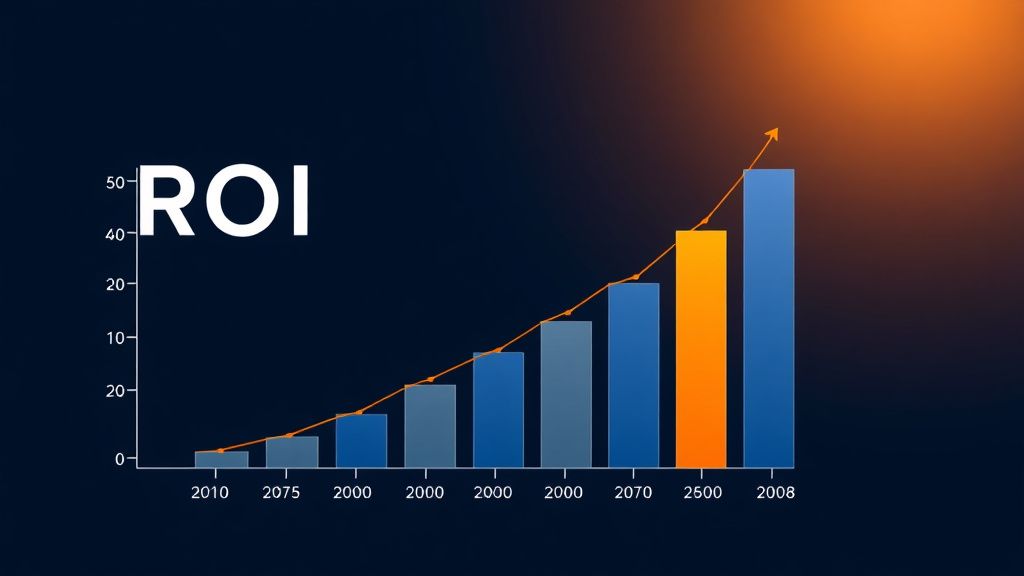 *Real numbers from a 3-person service business using AI for 6 months.*
---
Real 2026 Case Studies
Case Study 1: 3-Person Retail Shop
The business: Boutique home goods store, 3 employees, $450K annual revenue
AI tools implemented:
- AI email responses (customer service)
- AI social media scheduling
- AI inventory alerts
The numbers:
| Metric | Before | After | Annual Impact |
|--------|--------|-------|---------------|
| Owner hours on admin | 15/week | 6/week | 468 hours saved |
| Hourly value | $75 | $75 | $35,100 |
| Tool cost | $0 | $89/month | -$1,068 |
| **Net ROI** | — | — | **3,189%** |
Quote from owner: *"I got my evenings back. That's worth more than the money."*
Case Study 2: Service Company (HVAC)
The business: 8-person HVAC company, $1.2M annual revenue
AI tools implemented:
- AI scheduling and dispatch
- AI quote generation
- AI follow-up sequences
The numbers:
| Metric | Before | After | Annual Impact |
|--------|--------|-------|---------------|
| Jobs scheduled/week | 24 | 31 | +7 jobs |
| Average job value | $650 | $650 | +$236,600 revenue |
| Admin hours saved | 20/week | 8/week | $62,400 value |
| Tool cost | $0 | $350/month | -$4,200 |
| **Net ROI** | — | — | **7,100%** |
Key insight: Most gains came from faster response times winning more jobs, not just time savings.
---
When to Kill an AI Tool (Red Flags)
Cancel immediately if:
1. ROI is negative after 60 days - You're spending more than you're gaining - Exception: Tools with long setup (give 90 days)
2. Team actively avoids using it - Adoption matters more than features - If they won't use it, it can't generate ROI
3. Customer complaints increase - Some AI tools hurt customer experience - Monitor reviews and feedback closely
4. It creates more work than it saves - Some tools need constant babysitting - If you're fixing AI errors daily, it's not ready
Pivot (don't cancel) if:
- ROI is positive but lower than expected → Adjust settings, get training - One team member loves it, others don't → Find champion, get peer training - Works for some tasks but not others → Narrow scope, double down on wins
---
Benchmarks: What's Good ROI?
| Timeframe | Minimum Acceptable | Excellent | Exceptional | |-----------|-------------------|-----------|-------------| | 30 days | Break even | 2× return | 5× return | | 90 days | 2× return | 5× return | 10× return | | 1 year | 3× return | 10× return | 25× return |
My experience: Most well-chosen AI tools hit 3–5× return within 90 days. Tools that don't hit 2× by day 90 rarely improve.
---
Free Spreadsheet Template
Download: [AI ROI Calculator Template](/newsletter) *(available to SMF AI Weekly subscribers)*
Includes:
- Pre-built formulas
- Monthly tracking tabs
- Comparison charts
- Break-even calculator
Or build your own with these columns: - Date - Tool name - Hours saved (weekly) - Hourly rate - Revenue impact - Tool cost - Net ROI (formula)
---
The Bottom Line
AI ROI isn't magic — it's math.
Most small business owners who "don't see results" from AI are tracking the wrong things. They count features used instead of time saved. They measure logins instead of revenue impact.
Track the three numbers. Do the simple math. Make decisions based on data, not hype.
> 🔥 Forge It Yourself: "In God we trust. All others bring data." — W. Edwards Deming
---
Ready to Calculate Your AI ROI?
I've helped 50+ businesses measure and optimize their AI investments. Most find they're either: - Underestimating gains (missing hidden time savings) - Overpaying for tools (paying for features they don't use) - One adjustment away from 2× better results
[Book a free 20-minute call](/contact) and I'll help you calculate your actual AI ROI — no sales pitch, just clarity.
Or [subscribe to SMF AI Weekly](/#newsletter) for the free ROI calculator template and more practical AI insights.
---
FAQ: Measuring AI ROI
Q: What's a good ROI benchmark? A: 3× return within 90 days is excellent. Anything above break-even at 30 days is worth continuing.
Q: How do I calculate my "hourly value"? A: If you bill hourly, use that rate. If not, divide your annual income by 2,000 hours. Or ask: "What would I pay someone competent to do this task?"
Q: What about intangible benefits? A: Track them separately. Stress reduction, better sleep, more family time — these matter but don't go in the ROI formula. Use them as tie-breakers between similar tools.
Q: Should I include setup time in costs? A: Yes, for first-month calculations. Amortize it over year 1. By month 2–3, you should see positive ROI excluding setup.
Q: How often should I recalculate? A: Monthly for new tools, quarterly for established ones. AI evolves fast — today's winner might be tomorrow's loser.
Q: Can I trust vendor ROI calculators? A: Treat them as marketing. They use best-case scenarios. Run your own numbers with your actual data.
---
*Written by Michael, Principal AI Solutions Engineer & Founder of The SMF Works Project. When not building AI solutions, he's at the forge crafting metal by hand. [Read the full story →](/about)*