

AI content is everywhere — but most of it ranks nowhere. You have seen it: generic blog posts stuffed with keywords, no real insight, no personality, no value. Google has seen it too. That is why most AI content fails to rank.
 *The difference between AI content that ranks and AI content that disappears — strategy, structure, and human expertise.*
Read time: 12 minutes
Categories: AI, SEO, Content Marketing
---
Why Google Still Loves Human + AI Hybrid Content
Here is the truth Google will not say out loud: they do not care if you use AI. They care if your content is helpful, original, and demonstrates E-E-A-T (Experience, Expertise, Authoritativeness, Trustworthiness).
What Google penalizes:
- Generic content with no original insight
- Keyword stuffing that reads like a robot wrote it
- Thin content that does not answer the searcher's question
- Duplicate or near-duplicate content across your site
What Google rewards:
- Content that demonstrates real expertise
- Original research, data, or case studies
- Clear author credentials and authority
- Comprehensive coverage of the topic
- Satisfying the searcher's intent completely
The tool does not matter. The quality does.
---
My 5-Step Process That Beats AI Overviews
Google AI Overviews are pulling answers directly from web content. If you want to be the source they cite, you need to structure your content for extraction.
Step 1: Target the Right Keywords (Not Just Volume)
Wrong: "best software" (too broad, too competitive)
Right: "best project management software for HVAC contractors" (specific, intent-driven)
My process:
1. Use AI to generate 100 keyword ideas
2. Filter for low competition + high intent
3. Check what currently ranks (if AI Overviews appear, target featured snippets)
4. Prioritize questions your customers actually ask
Step 2: Structure for Extraction
AI Overviews and featured snippets love structured content:
- H2s that ask direct questions: "How much does HVAC software cost?" - Bullet lists for features: Clear, scannable benefits - Tables for comparisons: Side-by-side feature breakdowns - Bold key takeaways: After every section, summarize in one sentence - FAQ sections: Literal question-answer format at the end
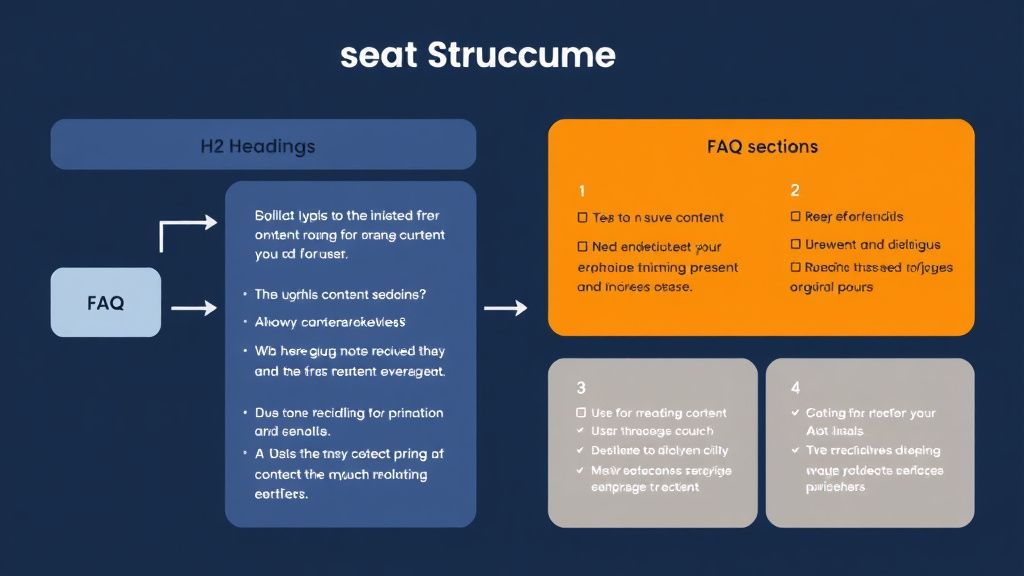 *How to structure content so AI Overviews can extract and cite your answers.*
Step 3: Add What AI Cannot Generate
This is where most AI content fails. You need to add:
Personal experience: "I have implemented this for 12 HVAC contractors..."
Original data: Survey results, usage statistics, pricing research
Case studies: Real examples with real results
Expert opinions: Quotes from industry leaders (or your own expertise)
Visual assets: Custom charts, infographics, screenshots
Rule: Every piece of content needs at least one element AI could not generate on its own.
Step 4: Optimize for Humans First, Search Engines Second
Readability checklist:
- Short paragraphs (2–3 sentences max)
- Subheadings every 300 words
- Bullet points for lists
- Images every 500 words
- Clear, jargon-free language
SEO checklist:
- Keyword in H1, first paragraph, and at least one H2
- Meta description that includes keyword and value proposition
- Internal links to related content
- External links to authoritative sources
- Alt text for every image
Step 5: Publish and Iterate
Week 1: Publish, share on social, submit to Google Search Console
Week 2: Check Search Console for impressions and clicks
Month 1: If not ranking on page 1, analyze top 3 results and improve
Month 3: Update with new data, expand sections that are performing well
---
Common Mistakes That Get AI Content Penalized
Mistake 1: Publishing Raw AI Output
What it looks like: Generic intro, repetitive structure, no real examples, reads like Wikipedia.
The fix: Use AI for first draft only. Then layer in expertise, examples, and personality.
Mistake 2: Keyword Stuffing
What it looks like: "Our AI SEO content services use AI for SEO content that ranks with AI SEO..."
The fix: Use keywords naturally. If it sounds awkward to a human, Google notices too.
Mistake 3: No Author Credentials
What it looks like: Blog post by "Admin" with no bio, no photo, no expertise demonstrated.
The fix: Author bylines with credentials, link to About page, showcase expertise in content.
Mistake 4: Thin Content
What it looks like: 500-word posts that barely scratch the surface of a topic.
The fix: Comprehensive coverage. If the top result is 2,000 words, you need 2,500+ with more depth.
Mistake 5: Ignoring Search Intent
What it looks like: Writing a sales page when someone wants a comparison guide.
The fix: Check what currently ranks. Match the intent: informational, navigational, or transactional.
---
The SMF Works Project Difference
This is exactly how we produce content for our clients:
1. AI-assisted research: Find gaps, generate outlines, identify questions 2. Human expertise layer: Add experience, data, case studies, opinions 3. SEO optimization: Structure for extraction, optimize for keywords 4. Quality review: Fact-check, readability test, plagiarism check 5. Performance tracking: Monitor rankings, iterate based on data
Result: Content that ranks, gets cited in AI Overviews, and actually converts readers into customers.
---
Will Google Penalize AI Content in 2026?
No. Google has explicitly stated they do not care how content is produced. They care about quality, helpfulness, and E-E-A-T.
But: Low-quality AI content will get penalized just like low-quality human content always has.
The key: Use AI as a tool, not a replacement for expertise. The businesses that figure out the human + AI hybrid will dominate search in 2026 and beyond.
---
Ready to Create Content That Actually Ranks?
I have helped small businesses go from page 10 to page 1 using this exact process. Most see movement within 30 days.
[Book a free 20-minute call](/contact) and I will audit your current content strategy — no sales pitch, just actionable insights.
Or [subscribe to SMF AI Weekly](/#newsletter) for weekly SEO and content strategies that actually work.
---
FAQ: AI Content and SEO
Q: Will Google penalize AI content in 2026? A: No — if it is helpful, original, and E-E-A-T strong. Low-quality content gets penalized regardless of how it is produced.
Q: How do I make AI content sound human? A: Add personal stories, specific examples, opinions, and your unique voice. Edit aggressively for flow and personality.
Q: What is the ideal content length for SEO? A: Long enough to fully answer the question. Check what ranks #1 and aim to be more comprehensive.
Q: Should I disclose that I use AI? A: Not required for SEO, but transparency builds trust. We disclose AI assistance in our process.
Q: How often should I publish new content? A: Consistency beats frequency. One high-quality post per week beats five mediocre posts.
Q: Can AI content rank #1? A: Yes — when it is properly edited, optimized, and enhanced with human expertise. Raw AI output rarely ranks.
---
*Written by Michael, Principal AI Solutions Engineer & Founder of The SMF Works Project. When not building AI solutions, he is at the forge crafting metal by hand. [Read the full story →](/about)*